top of page

THE BIG INTERVIEW. Hers is a story of a sailor in search of "firsts," driven by a desire to shatter the so called glass ceiling—without ever positioning herself as some kind of modern-day heroine. It is the story of a woman who, beyond the realm of competition, hopes to blaze a trail—to leave a wake that might lead others to follow, thinking: "Wait, is this actually possible?"

Alexia Barrier has been carving out this path for over 20 years, leaving an indelible mark this past January when she and her crew, ‘The Famous Project’, completed the first-ever all-female circumnavigation of the globe in 57 days 21 hours.  

Now this Route du Rhum the beginning of an exciting new adventure in the ULTIM class, the next chapter in the adventure.
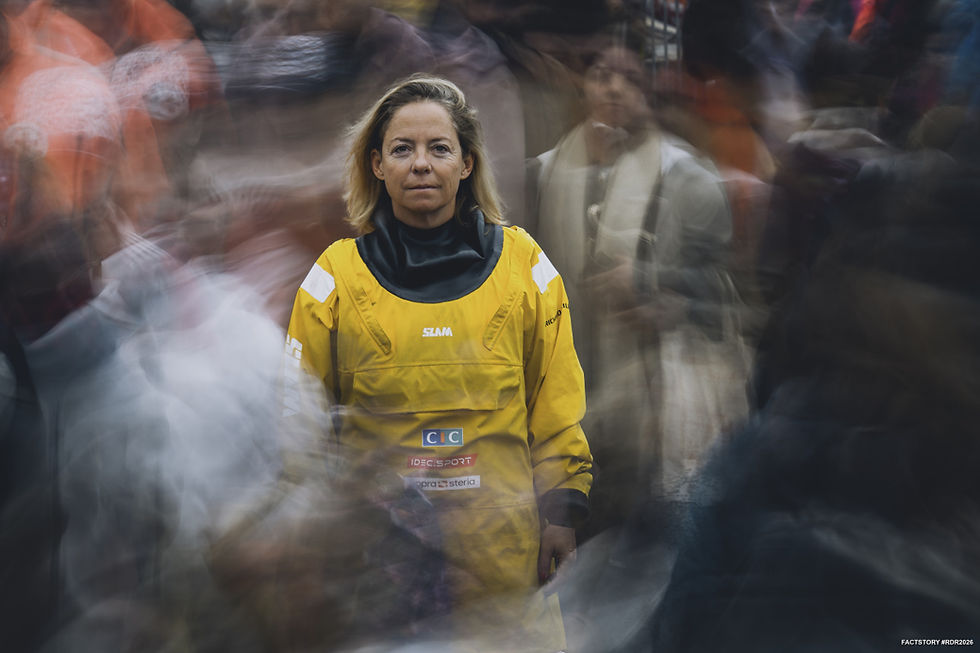

Alexia Barrier dans la foule de Saint-Malo (© Vincent CURUTCHET et Jean-Louis Carli / FACTSTORY)

Alexia we’re here in Saint-Malo, and you’re now based in Brest—yet, unlike many oceanic sailors, it wasn’t in Brittany that you first developed a love for the sea, was it?My first memory of sailing was in Antibes, with my dad on our 6-meter sailboat. He shared it with a colleague—an aircraft mechanic, just like him. I must have been about three and a half years old, and it immediately blessed me with a sense of freedom, fascination, and even creativity. That was the moment I realized the sea would be a big part of my life. That said, I didn’t head straight to a sailing school; I felt that stepping into an Optimist [a small, shoebox shaped beginner-level dinghy] after having learned on a 6-meter boat would be a step backward (laughs)! Instead, I took up basketball—which became another passion of mine—as well as horseback riding. I didn’t return to sailing until I was 14, when I started racing a Laser. At 18, I competed in the French U23 (Espoir) championships, where I finished fourth—but I stopped shortly after, as my small stature didn’t fit what the coaches were looking for.


Facing obstacles so early on—how did you keep going? I told myself there was more to life than just the Laser class, so I turned to match racing. In this format, it’s boat-versus-boat—a bit like the America’s Cup. I was the youngest on the team, acting almost like an acrobat, darting everywhere to drop or hoist sails and untangle knots. It reminded me of my role as the playmaker in basketball: reading the field and relaying information—only, instead of a ball, I was managing the boat. I was truly in my element.


How did you end up in the ULTIM class? After match racing, I returned to the traditional pathway—the Mini-Transat, the Figaro, and then the IMOCA class. Ever since I was a child, my dream had been the Vendée Globe; I couldn’t even imagine myself on a multihull—it seemed impossible. Then, in 2021, I completed my Vendée Globe. Having achieved that dream, another one began to take shape: sailing in the ULTIM category—racing a trimaran and taking on the Jules Verne Trophy. In February 2022, I called Anne Millet, whom I’ve worked with for several years, and said: "Anne, let’s put out a press release to tell the whole world at I won’t be doing another Vendée Globe—I’m moving into multihull sailing."


You are the first woman in the ULTIM category—is that a significant message? The mssage is out there and it matters to those who follow our adventures, as well as to the younger generations, especially young girls. But personally, I just see myself as a sailor on an ULTIM—me, Alexia—trying to do my best and exploring something new that I’m not yet familiar with.


Does it bother you to hear phrases like "first woman" or "only woman"? No, it doesn’t bother me, I take it seriously because, whether I like it or not, I’ve become a role model of sorts. At the same time, I find it a pity that, here in 2026, I’m still the "first woman" to do this. My ambition is for this to become the norm—for a woman at the helm of an ULTIM to no longer be an exception. It represents real progress, and I hope that by the next Route du Rhum, it will no longer even be a topic of discussion.

Your boat has won the Route du Rhum three times (Franck Cammas with Groupama 3 in 2010, Loïck Peyron with Banque Populaire VII in 2014, and Francis Joyon with IDEC SPORT in 2018). What is your personal connection to it? It had been catching my eye for a while. When I was putting together "The Famous Project"—an attempt at the Jules Verne Trophy with an all-female crew—I was having tea with Marie Tabarly. We looked at each other and said, "It would be really cool to get the 'red boat'." We both knew exactly which "red boat" we meant. The stars aligned, and Patrice Lafargue and the IDEC Group agreed to lend it to me. Since then, reality has surpassed the dream—a dream that was twofold: to sail an ULTIM, and to do it on the red boat. It’s reliable, easy to handle, and, on top of that, it’s the most decorated maxi-trimaran of all. This ULTIM is my superpower.


With The Famous Project, you set the women’s record for a crewed, round-the-world sailing voyage last January. The boat is configured for that—how do you go about working it for solo sailing? It’s quite fascinating; even though it’s the same boat, it’s not the same. It is a multihull with a double-cockpit control layout—which, when sailing solo, requires more moving around the deck than my competitors’ boats do—but I’m adapting; I’ve truly made it my own. The sequence of maneuvers is completely different. That’s why I brought in Loïck Peyron and Jean-Baptiste Le Vaillant to sail with me this summer. They gave me plenty of tips.


It’s difficult to compare IDEC SPORT-CIC with the other maxi-trimarans in the class in terms of pure performance; what is your ambition for this Route du Rhum? I’m not just going there to start the race and become the first woman in history to compete in the ULTIM class. I have a very clear understanding of my own level and that of my boat compared to the other competitors, but I’m going to give myself the best chance to fully exploit the boat’s potential—and my own—to achieve the best possible result. I’m a competitor.


There’s another essential factor for you: your shore team, which plays a significant role, right? Even though the Route du Rhum is a solo race, my projects aren’t about "Alexia Barrier the superwoman"—they’re about a collective of people who have bought into this dream and want to make it a reality alongside me. Without this team, it wouldn’t be possible. I might be able to juggle a dozen roles at once, but I can’t handle 100—yet they can! And that’s not even counting the energy and encouragement they provide.


You’ve sailed across all the world’s seas; what is your favorite place on the ocean?I don’t really have any favorite spots. I really enjoy sailing in the Mediterranean. It’s a multicultural place where you can travel from the northern coast to the southern coast, encountering a diverse range of landscapes and some truly extraordinary people. I also love being in the middle of the Atlantic. It brings back the feeling I had as a child with my parents—the sense of being in an entirely different world. Out there, I truly reconnect with my inner "sea creature." And then there’s the Great South—I’ve only been there twice, and I hope to return; it remains an incredible, majestic place. There are no man-made structures, no other human beings—it’s both fascinating and incredibly precious.


What’s the plan after the Route du Rhum?" The Famous Project" is a three-year project. The Route du Rhum will be a pivotal race, helping to ensure the boat’s reliability, build my confidence while sailing solo, and prove to myself that I am capable of completing such a crossing on my own—all as part of the ongoing preparation for the Arkea Ultim Challenge. After that, the goal is to set off on an all-female attempt at the Jules Verne Trophy.


Oct 30
6 min read

THE BIG INTERVIEW. Hers is a story of a sailor in search of "firsts," driven by a desire to shatter the so called glass ceiling—without ever positioning herself as some kind of modern-day heroine. It is the story of a woman who, beyond the realm of competition, hopes to blaze a trail—to leave a wake that might lead others to follow, thinking: "Wait, is this actually possible?"

Alexia Barrier has been carving out this path for over 20 years, leaving an indelible mark this past January when she and her crew, ‘The Famous Project’, completed the first-ever all-female circumnavigation of the globe in 57 days 21 hours.  

Now this Route du Rhum the beginning of an exciting new adventure in the ULTIM class, the next chapter in the adventure.


Alexia Barrier dans la foule de Saint-Malo (© Vincent CURUTCHET et Jean-Louis Carli / FACTSTORY)

Alexia we’re here in Saint-Malo, and you’re now based in Brest—yet, unlike many oceanic sailors, it wasn’t in Brittany that you first developed a love for the sea, was it?My first memory of sailing was in Antibes, with my dad on our 6-meter sailboat. He shared it with a colleague—an aircraft mechanic, just like him. I must have been about three and a half years old, and it immediately blessed me with a sense of freedom, fascination, and even creativity. That was the moment I realized the sea would be a big part of my life. That said, I didn’t head straight to a sailing school; I felt that stepping into an Optimist [a small, shoebox shaped beginner-level dinghy] after having learned on a 6-meter boat would be a step backward (laughs)! Instead, I took up basketball—which became another passion of mine—as well as horseback riding. I didn’t return to sailing until I was 14, when I started racing a Laser. At 18, I competed in the French U23 (Espoir) championships, where I finished fourth—but I stopped shortly after, as my small stature didn’t fit what the coaches were looking for.


Facing obstacles so early on—how did you keep going? I told myself there was more to life than just the Laser class, so I turned to match racing. In this format, it’s boat-versus-boat—a bit like the America’s Cup. I was the youngest on the team, acting almost like an acrobat, darting everywhere to drop or hoist sails and untangle knots. It reminded me of my role as the playmaker in basketball: reading the field and relaying information—only, instead of a ball, I was managing the boat. I was truly in my element.


How did you end up in the ULTIM class? After match racing, I returned to the traditional pathway—the Mini-Transat, the Figaro, and then the IMOCA class. Ever since I was a child, my dream had been the Vendée Globe; I couldn’t even imagine myself on a multihull—it seemed impossible. Then, in 2021, I completed my Vendée Globe. Having achieved that dream, another one began to take shape: sailing in the ULTIM category—racing a trimaran and taking on the Jules Verne Trophy. In February 2022, I called Anne Millet, whom I’ve worked with for several years, and said: "Anne, let’s put out a press release to tell the whole world at I won’t be doing another Vendée Globe—I’m moving into multihull sailing."


You are the first woman in the ULTIM category—is that a significant message? The mssage is out there and it matters to those who follow our adventures, as well as to the younger generations, especially young girls. But personally, I just see myself as a sailor on an ULTIM—me, Alexia—trying to do my best and exploring something new that I’m not yet familiar with.


Does it bother you to hear phrases like "first woman" or "only woman"? No, it doesn’t bother me, I take it seriously because, whether I like it or not, I’ve become a role model of sorts. At the same time, I find it a pity that, here in 2026, I’m still the "first woman" to do this. My ambition is for this to become the norm—for a woman at the helm of an ULTIM to no longer be an exception. It represents real progress, and I hope that by the next Route du Rhum, it will no longer even be a topic of discussion.

Your boat has won the Route du Rhum three times (Franck Cammas with Groupama 3 in 2010, Loïck Peyron with Banque Populaire VII in 2014, and Francis Joyon with IDEC SPORT in 2018). What is your personal connection to it? It had been catching my eye for a while. When I was putting together "The Famous Project"—an attempt at the Jules Verne Trophy with an all-female crew—I was having tea with Marie Tabarly. We looked at each other and said, "It would be really cool to get the 'red boat'." We both knew exactly which "red boat" we meant. The stars aligned, and Patrice Lafargue and the IDEC Group agreed to lend it to me. Since then, reality has surpassed the dream—a dream that was twofold: to sail an ULTIM, and to do it on the red boat. It’s reliable, easy to handle, and, on top of that, it’s the most decorated maxi-trimaran of all. This ULTIM is my superpower.


With The Famous Project, you set the women’s record for a crewed, round-the-world sailing voyage last January. The boat is configured for that—how do you go about working it for solo sailing? It’s quite fascinating; even though it’s the same boat, it’s not the same. It is a multihull with a double-cockpit control layout—which, when sailing solo, requires more moving around the deck than my competitors’ boats do—but I’m adapting; I’ve truly made it my own. The sequence of maneuvers is completely different. That’s why I brought in Loïck Peyron and Jean-Baptiste Le Vaillant to sail with me this summer. They gave me plenty of tips.


It’s difficult to compare IDEC SPORT-CIC with the other maxi-trimarans in the class in terms of pure performance; what is your ambition for this Route du Rhum? I’m not just going there to start the race and become the first woman in history to compete in the ULTIM class. I have a very clear understanding of my own level and that of my boat compared to the other competitors, but I’m going to give myself the best chance to fully exploit the boat’s potential—and my own—to achieve the best possible result. I’m a competitor.


There’s another essential factor for you: your shore team, which plays a significant role, right? Even though the Route du Rhum is a solo race, my projects aren’t about "Alexia Barrier the superwoman"—they’re about a collective of people who have bought into this dream and want to make it a reality alongside me. Without this team, it wouldn’t be possible. I might be able to juggle a dozen roles at once, but I can’t handle 100—yet they can! And that’s not even counting the energy and encouragement they provide.


You’ve sailed across all the world’s seas; what is your favorite place on the ocean?I don’t really have any favorite spots. I really enjoy sailing in the Mediterranean. It’s a multicultural place where you can travel from the northern coast to the southern coast, encountering a diverse range of landscapes and some truly extraordinary people. I also love being in the middle of the Atlantic. It brings back the feeling I had as a child with my parents—the sense of being in an entirely different world. Out there, I truly reconnect with my inner "sea creature." And then there’s the Great South—I’ve only been there twice, and I hope to return; it remains an incredible, majestic place. There are no man-made structures, no other human beings—it’s both fascinating and incredibly precious.


What’s the plan after the Route du Rhum?" The Famous Project" is a three-year project. The Route du Rhum will be a pivotal race, helping to ensure the boat’s reliability, build my confidence while sailing solo, and prove to myself that I am capable of completing such a crossing on my own—all as part of the ongoing preparation for the Arkea Ultim Challenge. After that, the goal is to set off on an all-female attempt at the Jules Verne Trophy.


bottom of page