
It is the day before the start of the Route du Rhum Destination Guadeloupe and the start town of Saint-Malo is in its pomp. Usually the tens of thousands of visitors thronging the docks and pontoons are doing their best to ignore the Autumn weather and to enjoy the spectacular dock out shows, their last chance to bid farewell to the intrepid solo skippers in person.
But, after a stormy start to the 12 days that the huge village has been open, high pressure stretching up over the UK means these final pre-start days are stolen from summer. Instead of foul weather gear it is T-shirts, crepes and ice-creams, and the crowds, the skippers and the teams from the 115 boats are loving it.
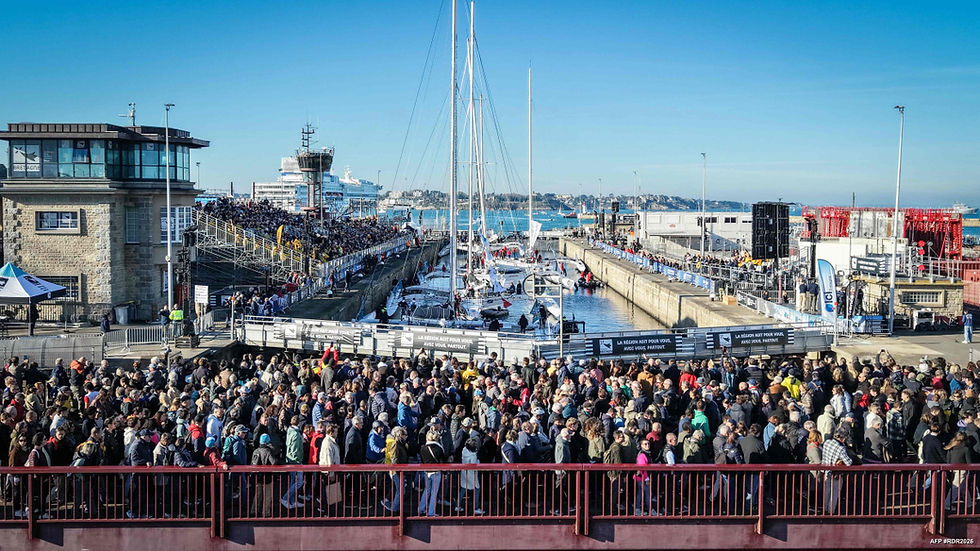
Yesterday and especially last night was party time in Saint Malo. For the public the extraordinary dock out of the Ultims, squeezing the giants out of the locks back into the sea, a fantastic sound and light show. And into the small hours of this morning, the time window to party opened.
Today it is back to business and final, final preparation for tomorrow’s 1302hrs (1202hrs UTC) start. It has been mainly about the dock out of the 22 boat IMOCA fleet and the Vintage Multi and Vintage Mono fleets and the skippers have enjoyed a beautiful send off by the public.
A sting in the tail
Of course the mood is enhanced by the promise of a good forecast. Instead of the vicious Biscay storms which usually stand between the racers and the trade winds fast route south, the routings take the fleet north of west more towards Ireland for a short, fast route north of the Azores. With no trade winds at all the sting in the tail is very much for the Ultims which, at the moment, seem set for a complex, very light winds approach to Guadeloupe. For sure it is not looking like a direct, speed drag race and that really opens things up.
For the Multihulls – Ultims and Ocean 50s – the battles will be won and lost as much by the routing cells on land as by the solo skippers. For the IMOCA solo skippers who have no such outside assistance, the big number of transitions after the Azores will be a real, possibly decisive test. Already tired from the need to maintain high speeds all the time over the first two or three days in what Francesca Clapcich (11th Hour Racing) described this morning as the inevitable IMOCA ‘dog fights’ it will be then be a very fine balance between keeping their boats at as close to 100 per cent speed as possible whilst taking time to work on the fine detail meteo strategy.
Intense and then some
The intensity is only going to increase after the Azores as a tactical and strategic race unfolds. For the IMOCAs especially the course looks like it will initially favour the downwind-reaching optimised speedsters, the likes of Jérémie Beyou (Charal) and Italian Ambrogio Beccaria (Allagrande Mapei) and maybe Corentin Horeau (MACSF). But while the downwind early phase seems to favour them the transition phases in the middle third of the cours and beyond could be good for Franco-Brit Sam Goodchild (MACIF Santé Prévoyance) who maybe has a boat best suited to changes lying in wait further down the course.
“We like it upwind and it is downwind.” Noted Goodchild after today’s weather briefing, “But the boat has got better downwind so we will wait and see. Lots of transitions which means it will be intesnse. I will enjoy start day it looks nice but it gets serious very soon.”
Ready for his first solo race on his new Malizia 4 Germany’s Boris Herrmann left the briefing saying “I am happy with this route, it looks interesting, it will be nice to know what happens at the start and then we can think about it two days in! Our boat is good everywhere but we have not had so much downwind training, we think Ambrogio should be fast in the normal trade winds scenario., “
And Clapcich added, “ I feel really good but this is not the day of the start, so it's a different. Looking at the routings it is unusual. If there is not really trade winds in the south, there is no other way to go. We will have to manage these low pressures, the system coming. Of course, every time you go east to west, you have to kind of go through it. You know, they come really quickly, you're not riding them. So it's a different way to race. But so far it looks it’s gonna be fairly fast. And it is always a battle, It's always a dog fight. You know, the level of the Imoca class is really high. The boats are getting really, really optimized. So yeah, it's gonna be a really good battle out there.”
Beccaria smiled, “ I feel good. It’s a bit of an unusual start—a bit strange, really—but I’m in good shape. Looking at the weather, there’s plenty of wind, and we’re moving along at a high pace. It might seem simple, but when you’re going this fast, life on board becomes incredibly demanding; the intensity required is immense, and choosing the right sail can be absolutely critical. Honestly, it’s a very delicate balancing act. The route we’re taking isn’t the usual one—we often pass south of the Azores, but this time we’ll almost certainly be heading north of them. And the biggest change is the absence of the trade winds; we won’t be dropping into that steady flow. We’ve been given a little break by the weather at the start, but after that, there are no favors to be had.”
He finishes, “There are some fantastic boats out here, and the skippers are incredibly talented. That’s exactly why I’m here—for the battle. It’s shaping up to be epic.”
Downwind start In the history of the Route du Rhums you have to go back to the 2010 edition for the last downwind start. On Sunday all the boats will cross the north-south starting line on a starboard tack (with the wind coming from the right). But not all of them will be able to make a direct course to Cap Fréhel and the buoy there, located 16 miles away. This is particularly the case for the Ultims, which likely won’t be "flying" (foiling) and will need to execute two gybes to clear the cape.
"It will be quite demanding, as the maneuvers will involve the boats' biggest sails," predicts Sébastien Josse, technical director for Team Banque Populaire. "If the wind picks up in the gusts, the boats could reach speeds of 30 knots. It will be an intense half-hour or so, involving two gybes—and likely a sail change—with the boats accelerating sharply again until they clear Fréhel. It’s going to be technical; there will be other boats nearby, so it will require a great deal of concentration in a very confined space."
All of the fleet go off the same start line – albeit it is segregated by class - close-quarters situations are precisely what the Race Committee hopes to avoid. Yesterday, they waited until the weather forecast was as precise as possible before releasing the exact coordinates for the racing zones and the designated areas for spectator vessels. "The area is well-secured, but there will be points where competitors’ paths cross—notably between the Ocean Fifty or ORMA multihulls, which will be gybing several times, and the IMOCA monohulls, which might be able to reach Fréhel on a single tack, given that they are starting from the southern end of the line with a more favorable angle," explains Yann Château, a weather expert for the Race Committee.
Everyone will need to be on extra high alert, especially as the monohulls, Class40s, "Vintage" monohulls, and some IMOCAs equipped with daggerboards will be sailing under spinnaker, making them less maneuverable.
Something new in the West!
An anticyclone is centered over the north of Ireland, with another over the Washington. A low-pressure system over Greenland—while not directly affecting the competitors—has a cold front that is wreaking havoc on the trade winds, cutting across the Atlantic all the way to the Tropic of Cancer.
"It’s a complete mess of a weather pattern!" says Jean-Yves Bernot, who is routing for ‘SVR-Lazartigue’ alongside Franck Cammas.
And so the start promises to be fast, with the various classes all converging on a west-northwesterly heading. The Ultims will be the first to execute a gybe—likely during the first night, south of the Fastnet—while the back of the fleet will do several gybes just to clear the English Channel.
This opening phase, in an E’ly flow, is set to be fast and intense, with winds "strengthening to 20 knots, with gusts of 25–30 knots by Monday," according to Cyril Duchesne of Météo Consult, who presented this afternoon’s weather briefing.
Tuesday at the Azores for ultims
By Tuesday afternoon, the Ultims should already be passing the Azores; we might see speed records broken across several classes—including the Ultims, IMOCA, Ocean Fifty, and Class40. The skippers have packed extra layers to endure long hours on watch at the helm, setting up for a dry, cold spell that looks set to persist for quite some time.
Indeed, things get significantly more complicated starting Wednesday. A low-pressure system is forming near the Azores and will affect the second half of the fleet. The fastest boats will have crossed the trough between two high-pressure systems—a critical first test—but those further back will have no clear opportunity to gain ground to the south. Across all classes, boats will be forced to stick to a northern route.
"Everyone will favor a northern route though there may be variations in positioning, with some mid-latitude routes potentially emerging," notes Yann Eliès, notes the weather router for Upwind by Mer Concept: "Even the southernmost routes pass north of the great-circle route (the direct path). And as of today, none of these routes are winning options. The trade winds are all the way down by Cape Verde—you’d have to row rather than sail to reach them!"
Given this situation, the routing forecasts—which looked very favorable the day before yesterday—now suggest that the first boats won’t arrive in Pointe-à-Pitre until next Sunday at the earliest.
"The final stretch is highly uncertain, and some major decisions will need to be made regarding how to approach the Caribbean archipelago. But only 15% of the ensemble model runs show the leaders arriving within seven days."