
For the first time, the skipper of the Maxi Banque Populaire XI has opened up about his vessel’s capsize. After arriving in Norfolk, Virginia (USA), Armel Le Cléac’h reunited with his wife, Aurélia Le Cléac’h, and the sports director of Team Banque Populaire. In an extensive video and an official statement, he discusses the capsize and his subsequent rescue in detail, while also looking ahead to what comes next.
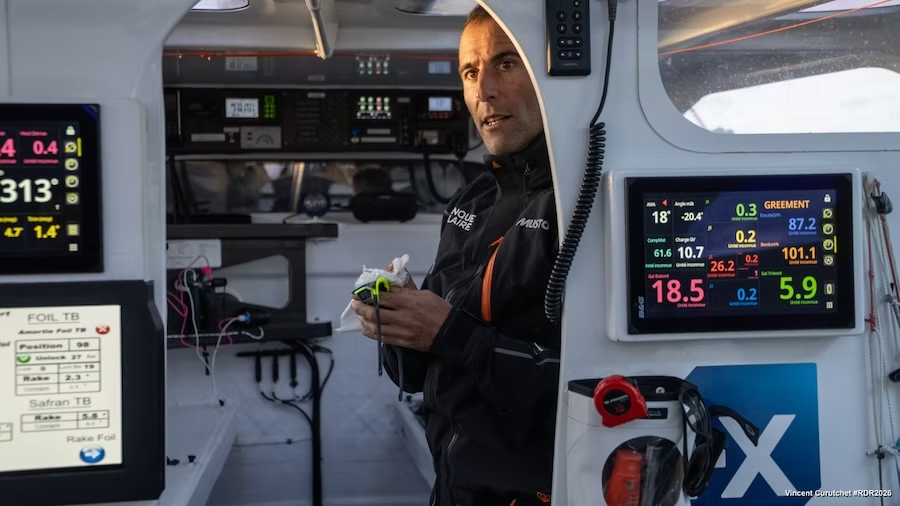
The accident. “Before the accident, everything was going well on board. I think we’d had a good start to the race—the boat, the weather team, and I were right in the mix, neck and neck with *SVR-Lazartigue* and Tom (Laperche). I was about to navigate through a patch of stronger wind, accompanied by a wind shift. I was preparing to tack, knowing we needed to get ready for a weather front. I had already reduced the sail area. Then, in a matter of seconds, everything turned—it happened incredibly fast, and it was truly brutal. It was an extremely violent gust of wind; my team later told me it reached 40 knots. It was nighttime, and the boat tipped onto its side almost instantly. Even the anti-capsize systems weren’t enough to compensate for the sheer violence of the moment.”
The capsize. “I realized very quickly that something extremely serious was unfolding. My first instinct was to hold on. I was in the cockpit and managed to grab hold of something as I scrambled toward the entrance to the companionway of the central hull.” I managed to get inside quickly, before being overwhelmed by water or the boat’s violent motion. Then, of course, the boat capsized completely; alarms started blaring, and everything went dark. I immediately took steps to secure my situation, activating the distress beacon. I then put on my survival suit and gathered all the safety equipment kept on board for such emergencies. Unfortunately, because the boat is built entirely of carbon fiber, the satellite signal for my emergency phone struggled to get through—it took some time to find a strong enough connection to send an initial message ashore, confirming that I was safe and uninjured.”
The experience. “It felt like a nightmare—completely unexpected. Everything turned upside down in a matter of seconds. I couldn’t wrap my head around it. I felt as though I’d ruined everything; the disappointment was immense, especially since I wasn’t out of the woods yet. A little later, I learned that a cargo ship would arrive in 7 to 8 hours. I knew I needed to rest, as the rescue operation with the cargo ship would likely be physically demanding. I managed to salvage some water and a bit of food, and I forced myself to eat and drink so I’d have the strength to be evacuated.”
The rescue. “This was the first time the crew of the cargo ship (Palexpo) had ever rescued someone on the open sea. It took several attempts, as the sea was rough and the wind remained quite strong.” “It wasn’t easy for them to position themselves without potentially putting me in danger or causing total destruction to the boat. I got my helmet and harness ready. But it was a complicated situation—I ended up in the water, right at sea level, with the cargo ship about twenty meters away, held on by a rope that was keeping me alive.”
As for what comes next… there’s a sense of relief, of course, but the phase that follows is one of decompression—a feeling of being completely shattered. Ending up on a cargo ship in the middle of the Atlantic is hard to come to terms with. Still, I’m lucky to be alive and uninjured, so I’m trying to keep things in perspective. The crew of the cargo ship welcomed me with great kindness. I learned a lot during the six days I spent at sea with them. Once I’m back in France, I’ll need to shift my focus to other things, and also sit down with my team to take stock and understand everything that happened to me. For now, though, I’m just trying to take it one day at a time.”