

THE BIG INTERVIEW. Having a young Bourgnon on the starting line of the Route du Rhum Destination Guadeloupe writes a new chapter in the long history of the race. Nearly thirty years ago, Laurent Bourgnon won the race twice both times in commanding fashion (1994, 1998). Sadly Bourgnon disappeared in 2015 in French Polynesia.
Now, it’s his talented son Basile’s turn, who at just 24 is sailing his 2025 launched boat Edenred, one of the outstanding favourites in the Ocean Fifty class . Having delivered an impressive performance throughout the season, he is frequently mentioned as a contender for victory. He sat down for an in-depth conversation.
It was earlier this week—though, in the context of the Route du Rhum race village, that feels like an eternity ago when Bourgnon settled into our press room, having just arrived in Saint-Malo. This was before the whirlwind of back-to-back interviews, constant demands, the approaching storm, the evening events, and the official presentation of the skippers.
Even as a favorite in the Ocean Fifty class, Basile manages to keep his feet firmly on the ground. Now, nearly thirty years after his father’s double triumph, it is his turn to shine..
When you’re this competitive and truly in the running for the win, is there any room to actually enjoy yourself while at the race village? Yes, of course! We do this job to experience intense emotions—that applies just as much on land as it does at sea. It’s a unique atmosphere—one I experienced first hand four years ago when I accompanied Emmanuel Le Roch (the Edenred skipper at the time). When we passed through the lock gates earlier this week, the team said to me: "Well, man, we’re here—there’s no turning back now!" »
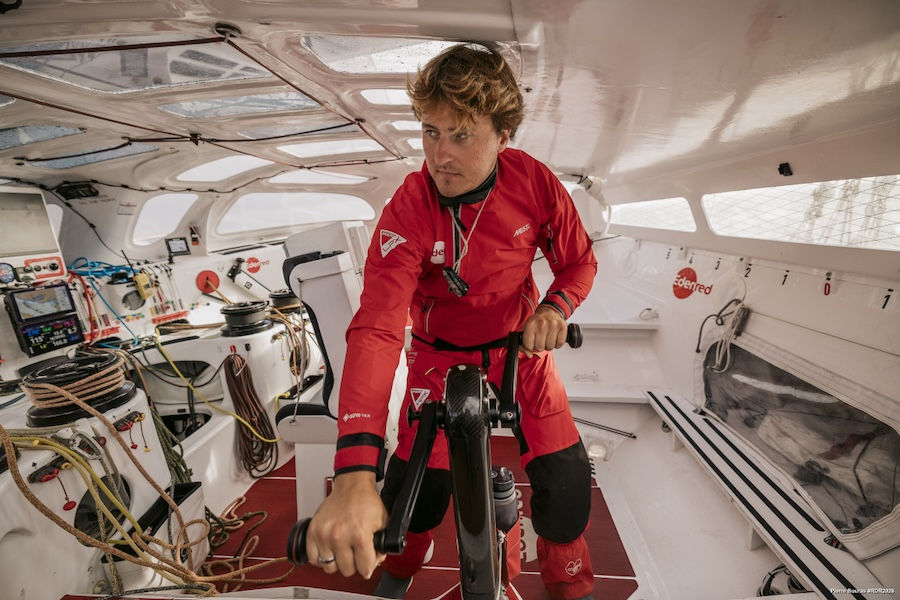
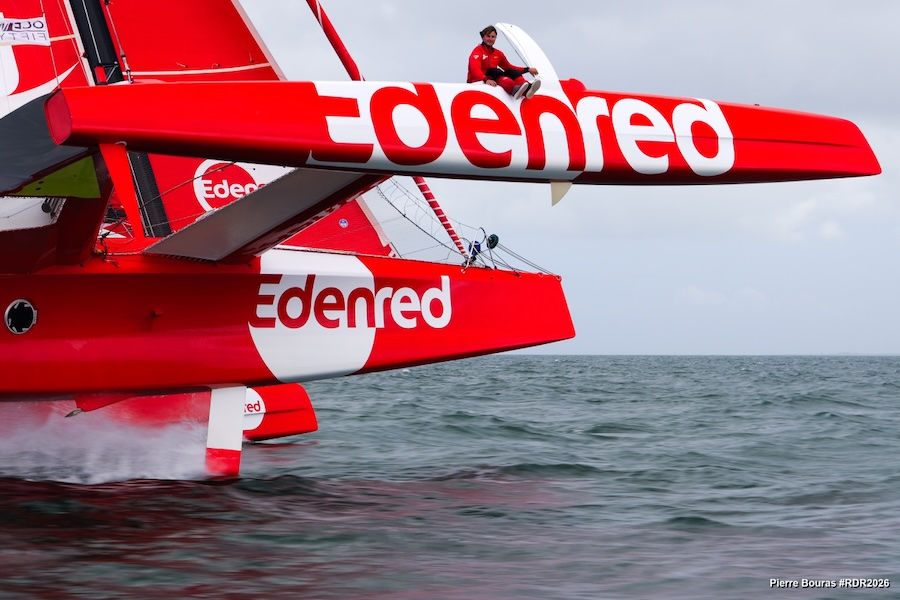
How would you describe the battle that lies ahead for the Ocean Fifty fleet? This is a big tough race. You can’t just head into it unprepared or take it lightly. Our Ocean 50 boats demand a great deal of energy, attention, and precision. If you don’t handle them well, they can be dangerous. But once you’re underway, they are extraordinary machines—light, fast—I’d even say they’re alive! The power-to-weight ratio is insane.
“The start of the race isn’t a slow, ‘diesel’ affair—it’s high-voltage from the gun!”
There’s a constant balancing act when it comes to taking risks…Essentially, there’s a line you shouldn’t cross. On these boats, you’re always walking a tightrope. And yet, if you don’t push right up to that limit, you just won’t win! The standard within the class has risen over the last few years. Average speeds are higher, and we’ve all shifted the red line bit further. The intensity is much greater. The start of the race isn’t a slow, ‘diesel’ affair—it’s high-voltage from the gun.
Even though the field is wide open, you’re frequently tipped as a favorite. Does that make sense to you? Given the season we’ve just had, I can’t really argue with that. We’ve continued to develop the boat, always striving to get the absolute best out of it. I’ve also added my own personal touch to the interior layout—specifically to ensure I can get proper rest. In a race like the Route du Rhum, that can be a significant advantage. How do you actually get ready for a battle this intense, lasting some ten days? Honestly, I have no idea! The longest I’ve ever spent sailing this boat solo was just under three days (during the Drheam-Cup 2026, which he won). It was an intense, frantic pace—I only managed two hours of sleep… I know I couldn’t keep that up for ten days! But adrenaline and the desire to win keep you going. We’re also lucky to have routers [shore-based navigators] who push us and help us maintain our rhythm. At a certain point, you almost turn into a "robot" to keep the machine moving at the absolute limit of its capabilities.
"I think that even if he hadn’t been my father, I would have admired the athlete he was."
Is there any room to actually enjoy yourself during a race?Certainly not all the time. It can be stressful, even frustrating—especially when things don’t go the way you want. But I always make sure to step back a bit, because I do want to enjoy the experience. We get to live through some truly fabulous moments. And then there are the sunrises and sunsets—everything you see out at sea—those are things I hold onto very clearly.
Seeing you sail a multihull inevitably brings your father to mind. And yet, this calling didn’t come from him… That’s absolutely true. I started very young, at age 11. I was too big for an Optimist [dinghy], so the only way to keep going was to switch to a catamaran. We had repaired a Hobie Cat that had washed up on the beach; my father bought it, and I’ve been sailing ever since. Even though I’ve sailed in the Mini and Figaro classes, I feel that it’s in multihulls that I’m truly in my element.
It’s impossible not to think of your father when seeing you compete in the Route du Rhum – Destination Guadeloupe. How do you feel about the fact that this is a constant topic? I can’t deny that history—and, in a way, it’s my own history, too: I’ve wanted to sail for a very long time. As for my father, it’s primarily... ...he is an example to me. I really only learned about his career after he had gone. I think that even if he hadn’t been my father, I would have admired the athlete he was. In a way, he was such a pioneer in many respects.
What’s fascinating is that he never pushed you to follow that path…No, never. We did live on a boat, so naturally, there’s an appeal. But I also tried many other sports when I was young. The only thing that mattered to him was that I saw whatever I was doing through to the end.
You lived on a boat with your family for seven years, didn’t you? Would you say that the trust and autonomy you were given are the key takeaways from that experience?
Yes, that was the style of upbringing my father provided. We always had a great deal of freedom to express ourselves and to be very independent. At the same time, he held us to very high standards. I didn’t spend much time in school, but I was fortunate enough to be self-taught—to learn from what I observed. The greatest quality my father passed on to me is the ability to adapt to any situation and any person.
How would you describe the person you are when you’re at sea?
When I’m at sea, I’m in my element! Even though I am aware of its dangers, I feel like I’m in my element—it’s a bit like home… And I love the humble nature of the sea—the fact that you have to adapt to the sea, rather than the other way around.