


THE BIG INTERVIEW.
At 50, Jérémie Beyou is preparing to compete in his final race representing Charal. His boat has undergone a radical overhaul, virtually creating a new hull to improve performance. Beyou is consistently named among the race favorites. He has already finished 3rd (in 2022) and 2nd (in 2014) in the Route du Rhum. As ever his sights are set on only one outcome: victory.
Jérémie Beyou has shown incredible consistency in the Route du Rhum - Destination Guadeloupe. H He has been a constant presence in the race since 2006. A highly talented skipper he has experienced some highs and lows including the disappointment of having to retire (in 2006 and 2018), as well as two podium finishes—2nd place in 2014 and 3rd in 2022.
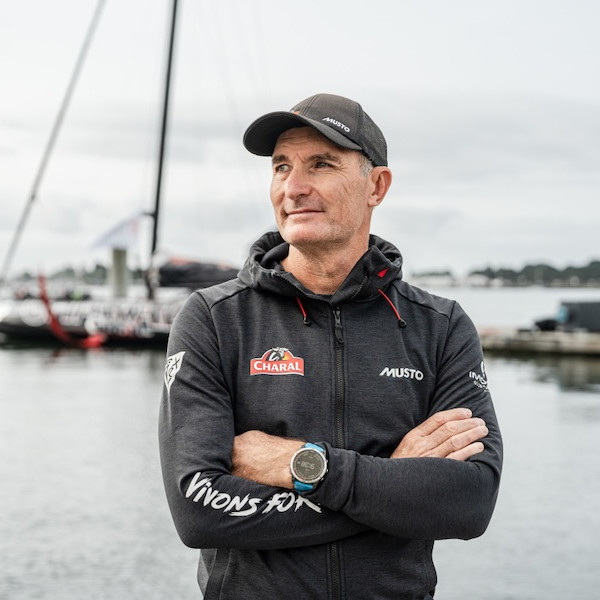
On the last edition in 2024 he was part of an intense, high-stakes battle against Thomas Ruyant (winner) and Charlie Dalin (second). Now some four years later, Jérémie returns with a significantly revamped, high-performing boat. Having won the most recent double-handed transatlantic race (the Transat Café L’Or), he dreams of a grand finale to his journey with Charal, who have been his main sponsor for the past decade.
You are setting off under unique circumstances, as this is your final race representing Charal. Has it been a psychological challenge trying to focus solely on the sporting side of things?
Yes, inevitably—it’s a unique situation. When you’re on land, it can sometimes feel like people are focused solely on external factors. You have to manage to stay truly focused—much like at sea, where you have to learn to "switch" your mindset and concentrate exclusively on the smooth running of the boat. It’s not an easy exercise, but it’s a valuable one.
This is your sixth Route du Rhum. What makes this race so special to you? I remember the editions from the 1980s and 90s from when I was a child. Growing up in northern Finistère, as a family we would go to watch the start, and then, on Sunday evenings, we’d see the lights of the boats—the competitors—passing by in the distance from our home. After watching the start, we’d listen to the radio, watch the TV show ‘Thalassa’, and read and re-read ‘Voiles et Voiliers’ magazine. Naturally as soon as you are back in the race build up and so on, on every participation, those memories come flooding back. There’s always a bit of that child or teenager’s perspective that resurfaces whenever the Route du Rhum is mentioned.
"We’ve gained performance in certain points of sail."
You’ve taken part in every edition since 2006. What does this consistency say about you? I’ve managed to secure long-term partnerships. While my projects are centered around the Vendée Globe, the intention has always been to remain active in other races as well. It’s been very important to me to build my work and my progress over the long term. That’s one of the key traits that defines me.
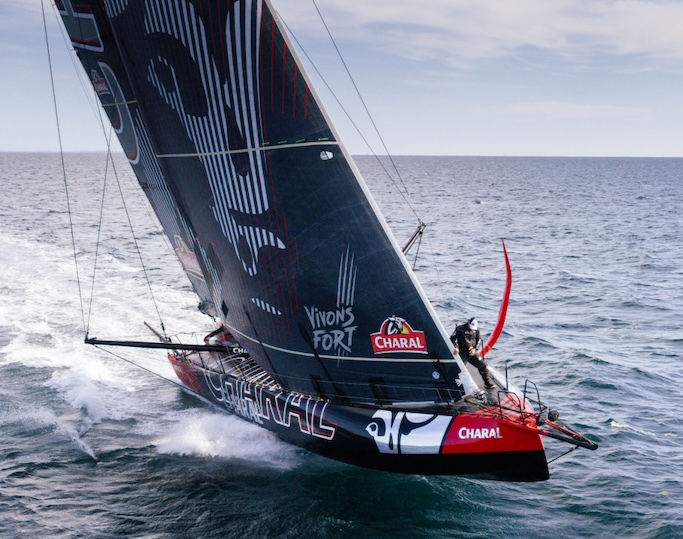
You undertook a massive refit, replacing the entire hull of your boat. What are the performance gains?I’m very happy with it. From the very first time I took it out, the feeling was excellent. Right from the first impression, you can feel a clear difference. Looking at the data, it’s evident that the numbers are much better than last year, especially when sailing upwind. We’ve definitely gained performance in certain points of sail!
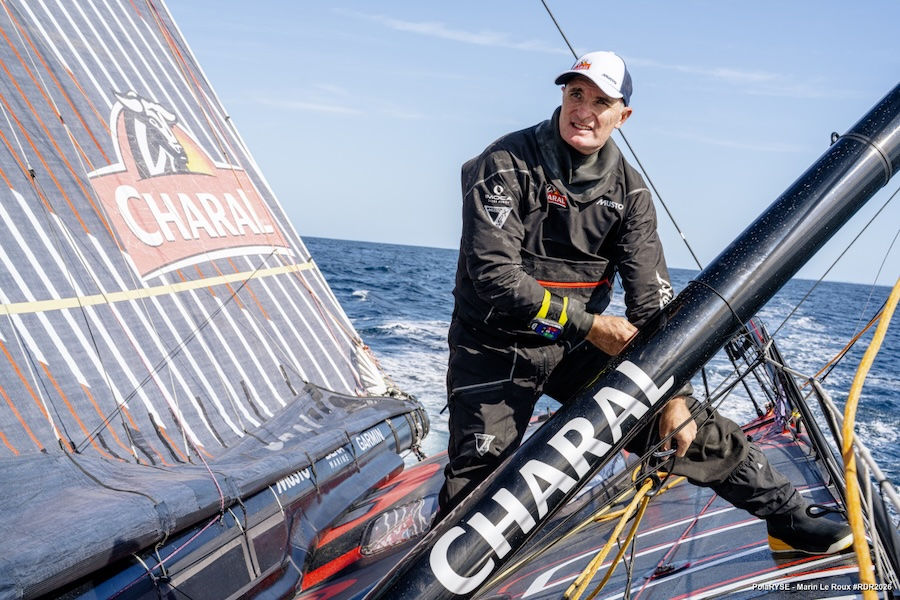
You relaunched your boat in June, while most others began their preparations back in the spring, yet, you seem very composed. Yes, in terms of technical preparation, we’re right on schedule. From a competitive standpoint, we certainly had to make up for some lost time. That’s also why I decided to take part in a few Figaro races earlier this year—to keep up to speed and to maintain my instincts for solo sailing. The challenge is to stay 100% focused on the start of the Route du Rhum—on myself and on my boat—so that I’m in the mix right from the start.
“Solo sailing requires a broader range of skills.”
Do you consider Sam Goodchild (Macif) the favorite in the IMOCA class? He might be a small step ahead. You can see that he’s very consistent across different phases of racing, especially at the starts. Everything that happens earlier in the season certainly helps in being well-prepared for the start of a major race. But the Route du Rhum also involves an open course; you have to make the right strategic choices, maintain good speed, stay alert to unexpected events, and manage a multitude of unknowns. I think it’s hard to predict who will win among the five or six skippers who are genuine contenders for victory.
Does the fact that it’s a solo race ultimately “open up” the competition even more? Yes, absolutely. In double-handed sailing, things inevitably level out: a good meteorologist will team up with an excellent sail trimmer, and a good sail trimmer with an excellent meteorologist. But when sailing solo, each person must rely on their own individual strengths. But it brings its own set of flaws. It requires a broader range of qualities, which can certainly make a difference at the margins—especially in the event of a tight finish.
Before the big start, there’s the whole "race village" phase. Is that a part you enjoy? Yes, I do! It’s a friendly atmosphere, and it’s quite impressive to see the walled city, the ramparts, and this vast race village. Plus, you can easily slip away for a walk along the Sillon beach to catch your breath. There’s also the passage through the locks, the night spent at anchor in Dinard—the whole spectacle surrounding the race. Naturally, it demands a lot of energy, and sometimes you have to know how to step back from it all. But it’s also important to know how to enjoy it!