
Germany’s Boris Herrmann leads one of the biggest, most ambitious IMOCA programmes in the world. With a brand new boat, Malizia 4, just launched in July this year the 45 year old from Hamburg is set to start the Route du Rhum for the third time.
Fifth place on the 2020-21 Véndee Globe, reaching the Bay of Biscay with a fighting chance of victory, really ignited a huge following at home in lockdown Germany. His sporting performance was but one element, daily he unfolded his story with clarity and emotion and his race engaged an audience all over the world.
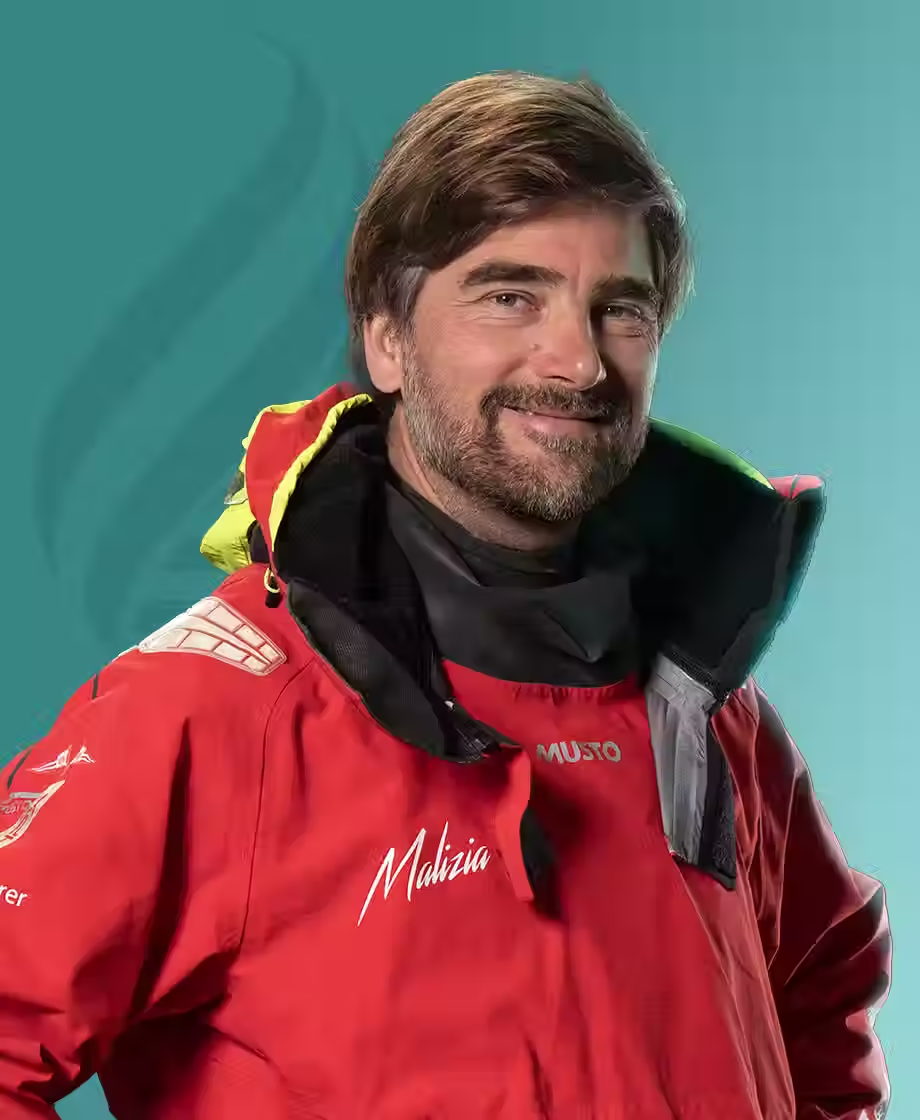
As a kid Boris grew up in Northern Germany reading and following the exploits of legendary French sailors but also the crewed races around the world. Now he and his team have built a campaign which pursues the solo and the crewed pinnacle races at the highest level. Herrmann seems entirely untroubled that this solo ocean sprint to Guadeloupe will be his first long period on a new boat which is much more demanding to sail than Malizia 3 which was powerful, designed to go best in the deep South.
But maybe it is too easy to forget he has such a long and diverse history on the ocean and inshore, from being the youngest skipper on the 2001 Mini Transat to racing round the world on a Class 40 to challenging for the Jules Verne Trophy with Frances Joyon and setting records with Italian Giovanni Soldini. He has six circumnavigations under his belt, finishing third in The Ocean Race before doing his second Vendée Globe in 2024.
Your schedule with your new IMOCA is tight, no other new boats are doing the Route du Rhum and The Ocean Race, so this is important to you?
For me the Route du Rhum is not just a race like the others, I don't feel about this race just as another race, just a sport exercise, especially here when you are here in the middle of this crazy public that comes here, so many people. It gives us energy. This is a legendary race and we want to be part of the legend.
Compared to the last time you were here with a new boat how do you feel?
I feel more at ease. I don't feel any particular pressure, I really push it away as well. It feels like a great freedom and it makes me happy to be here. We are here because we love this sport. The passion for this French thing inspired me when I was a kid. I had never been outside of northern Germany until I was doing the Mini Transat. This kind of sailing that made me travel for the very first time to another country. And since then I have discovered the world. And I just feel connected to this race. I don’t necessarily love the crowds. But there are these short moments of mystery, like the light in the evening when they do the light show here. Or the big long jetty and the long beach where the waves break over the breakwater last night. It's good to be here.
And where are you in terms of the boat being ready for this race? I think we are pretty good for our main objective which is The Ocean Race. I think the boat has great potential as a team. That's our focus and also some of the technical choices. We have very long rudders make the boat a bit more on and off we feel. You can really hit the sweet spot and be in a great mode, finding good modes. Or you can be a bit draggy and not really on pace. For a crewed configuration we have really built confidence.
what I have is pretty amazing but it's not particularly optimised for solo sailing.
But does that worry you for solo? I always knew I'm not going to be able to focus on two things at once, the Ocean Race and the Route du Rhum. I focus on doing our best on the Ocean Race and that was always a clear choice, to honour the team and the team objectives that we had set four years ago. We stick to The Ocean Race as our main objective. And so that takes some pressure off me here. I will do the best I can with what I have. And what I have is pretty amazing but it's not particularly optimised for solo sailing.
How much solo sailing have you done on this boat? I have done four nights alone, in total I have done three and then one.
In solo mode is there a lot of difference between the boats? I would say so. This is very different than Malizia 3. Malizia 3 was a super tolerant boat. She can kind of almost heel at any angle or trim up the bow or be able to bow down and always progress in a nice average. I saw that especially in the two 2024 Transats when I was sailing along with big fleets going to New York and back to Les Sables. I had lots of occasions to sail with other people and I just felt at ease all the time. There were races with average quite good winds and then unstable winds. In unstable winds in particular I could see on Malizia 3 it was easier than Charal and Macif. I'm here now closer to a more temperamental boat that is a bit more capricious. It's a bit harder to sail in these gusty, windy conditions and in a sea state. But in medium conditions there is no comparison. It's like a lot faster. There is this one box in the polar diagram. It's a little box and you don't hit it that often. But it gives you an early take off upwind when you start flying upwind which we see with Macif for example. I think we can do the same. We can just take off in 15 knots of wind, 16 knots for sure.
How do you feel about going back solo? You know my big long term path is the Vendée Globe 28 -29.
There is space for the human to make a difference.
Do you have ‘a Boris’, a different character that you lock into when you are solo? No, I'm still searching for it. I start each time as if I've never sailed solo before. It's lots of improvisation. That's what essentially solo sailing is. And it's non-perfection. You have to be going to the essence very quickly. I am a bit like that anyway. I like to improvise. I like to not overthink. I like to take quick decisions, sometimes I'm really struggling. It is such a different way to crewed sailing. And I really like it. It's very intuitive. Sometimes you don't know why but you do something. It is really still a sport where there is space for the human to make a difference. In solo sailing, because it's imperfect, you cannot assume that you sail at 100% polar all the time.
This boat is less comfortable than the previous one in terms of life on board? One thing I like a lot, that's essential, is that the deck is lower. That means sitting in the cockpit I can look out at the sea. And this is just a key thing. What's the point of sailing around the world when you can't see the ocean? Before I was looking at a wall.
What were the key elements you sought in this boat? The starting point was (designer Antoine Koch’s) previous boat Paprec and it is an evolution of that. We can just be almost the same, but a bit better. The key step was being better upwind. And this has been achieved. Overachieved, I would say. Sometimes we look at the numbers and I can't believe it. Upwind is scary. Once upwind, I looked and saw 24 knots boatspeed.
How do you feel about having the busiest, hardest programme of every one, in terms of the number of races you're doing and the new boat? The setup we do with the team is very different than some other teams. It's a very special way that we have developed over many years. We have a very solid technical group. I don't have to be much involved. I'm on and off between Hamburg to see my daughter and France. And I don't have to be there physically at the boatyard every day but I'd love to be there. And that gives me a certain balance. Everything is relative, but it's my reality. I've been since many years now. It's on and off back to Hamburg and back to the racing. Ultimately this is kind of three-weeks. I come here, do the race, go back home. It's relatively quick. We alternate also with the seven sailors. The biggest difference to the other teams is that we are seven sailors. And we are a very strong skipper in Will Harris.
Did you ever hope for or think of a project of this scale 10 or 15 years ago? No, absolutely not. Yesterday, I was sitting in the technical van in the parking. And I remember the years of Malizia 2016-17, when we were basically living in the van. We had our coffee machine screwed down to the workbench. We had all the different drawers with ropes and balls and blocks and things. And we were touring the GC32. And this is essentially something that I really enjoy, being on the road with fun people. The essentials haven't changed. That's why we do The Ocean Race as well. And we have built a bigger, more solid structure around. And that helps us to also have the breadth and keep going.
And will you do another Route du Rhum in four years, say? That's something which I really enjoy. I enjoy the thought of being here and saying, you know, you can't take it for granted. Yesterday I spoke with Vincent Riou, and that is what is so particular in our sport that we also can be alongside our own legends. Like these people that we saw when we were kids