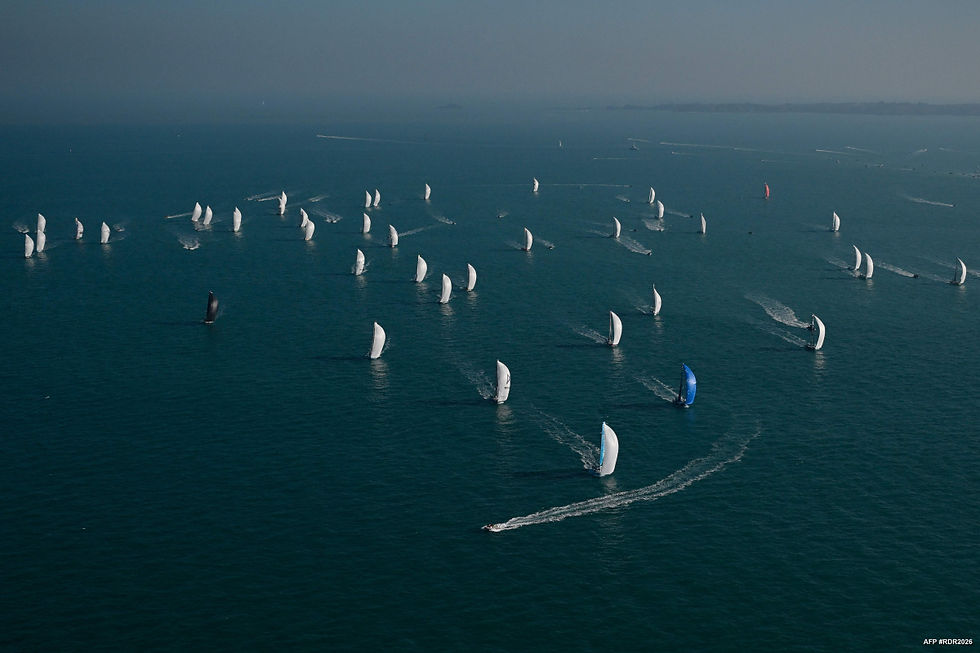
After a picture perfect start in bright Autumn sunshine and light, favourable winds off Saint Malo in Northern Brittany It is many of the pre-race favourites who are leading the 115 boat Route du Rhum Destination Guadeloupe fleet in the earliest stages of the solo ocean sprint’s 3542 nautical miles to Guadeloupe.
In winds of just eight to 11 knots from the north east, it was a much tamer start than many of the 12 previous editions of this legendary singlehanded race which was first contested in 1978 and which takes place every four years. The beautiful weather brought out hundreds of thousands of spectators who crowded on to every headland, especially Cape Frehel, the one and only passing mark, 16 nautical miles after the start.
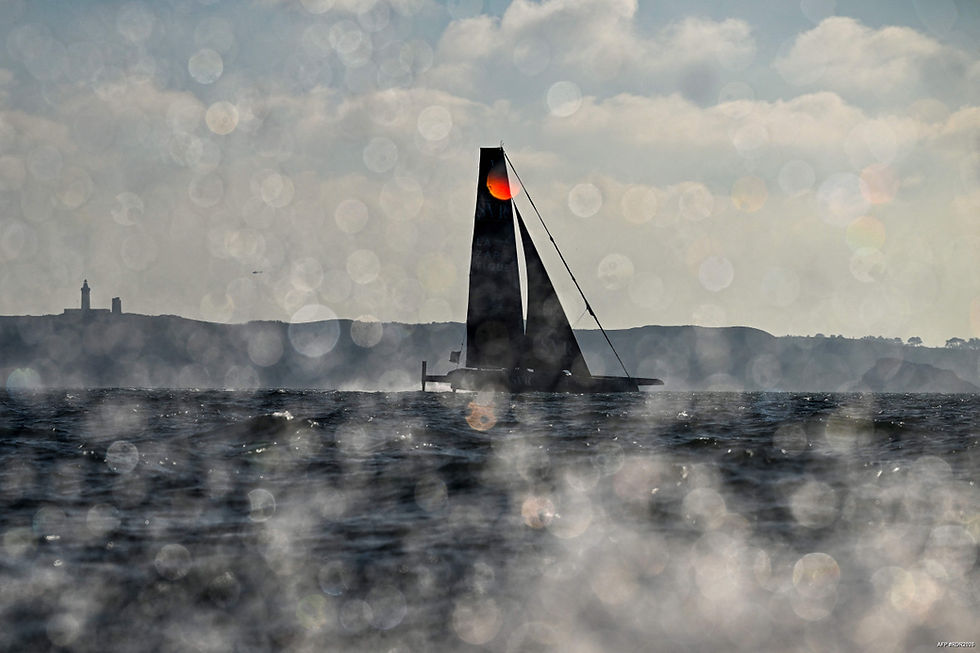
After 13 days of festivities in the docks of the historic ‘Corsair City’ all of the skippers racing in the six different classes – from the eight ocean giants, the 32m Ultims to diminutive 11m vintage trimarans the same as the one which won the first race – were all pleased to lock into race mode and to focus on what promises to be a fast but complex race to Guadeloupe.
At Cape Fréhel it was Tom Laperche on SVR Lazartigue which took a narrow lead over Armel Le Cléac'h on Banque Populaire XI. British born French based Sam Goodchild made an accomplished start on MACIF Santé Prévoyance and after the passage of the Fréhel mark was 1.3 nautical miles ahead of Italian Ambrogio Beccaria (Allagrande Mapei). For all that Goodchild is considered to have a boat strongest in upwind conditions, in the light to moderate downwind exit out of the Channel, Goodchild was slightly quicker than the Italian which races the IMOCA which won in 2022.
It is the 36 year old’s third time on the Route du Rhum, both previous attempts ending prematurely when racing in the Ocean 50 class four years ago and Class40 eight years ago. Winner of both the Défi Azimuth and the 1000 Race, preliminary races ahead of this pinnacle solo ocean sprint, Goodchild has been widely tipped as a possible winner this time.
“If I could win the Route du Rhum, it would of course be my greatest victory. But you can also have a great race without winning. My goal is to enjoy myself and especially to be proud of my performance when I reach the finish line.” He said in the lead up to today’s start.
In third was Violette Dorange the young sensation on the last Vendée Globe. Mentored by Brit Sam Davies, whose IMOCA Initiatives Coeur the 24 year old has taken over, Dorange started well and sailed smoothly on her well optimised boat.On his new Malizia 4 Germany’s Boris Herrmann was in seventh and Italian American Francesca Clapcich in ninth on 11th Hour Racing.
Standout favourite Guillaume Pirouelle (Sogestran Seafrigo) had assumed early control of the 49 strong Class40, notably quick on the downwind to Fréhel but with Quentin Le Nabour in second on Bleu Blanc Planete Location at around half a mile behind. Italy’s Andrea Fornaro (Influence 2) was best non French in 11th with the Czech Republic’s Milan Kolecek (Inland Roots Ocean Soul) in 19th on his brand new Class 40
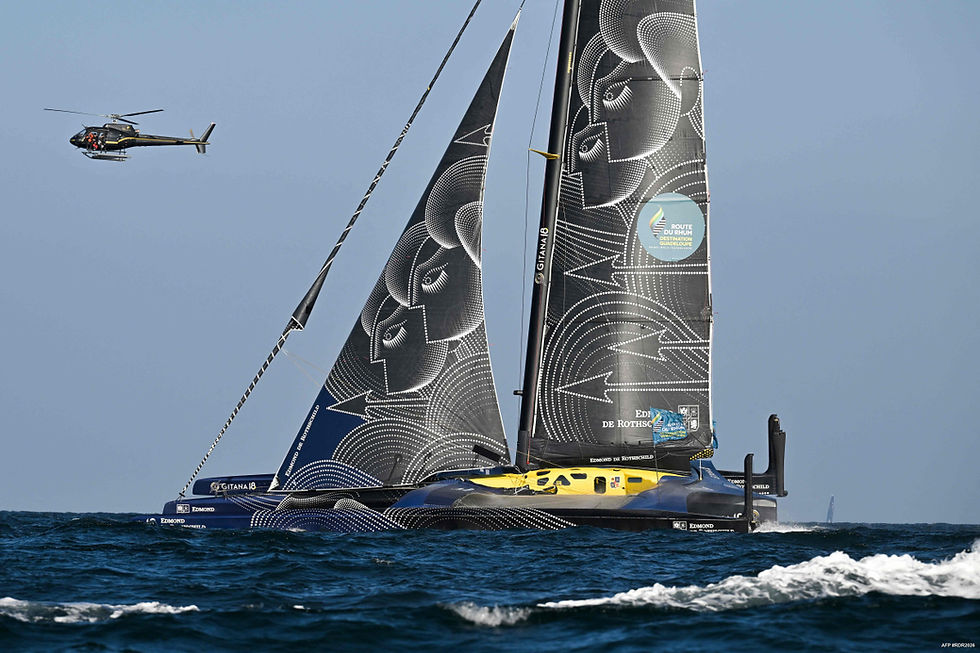
The brand new Ultime Gitana 18 seemed to struggle initially with its large appendages dragged through the water, but the new Maxi Edmond de Rothschild looked better once the wind picked up, allowing it to take flight—just like its rivals—and reach some impressive speeds. However, it is clear that transitions and maneuvers will not be Charles Caudrelier’s strong suits this year—which, to be fair, were expected. Every time the boat had to change course Gitana 18 clearly struggled to build up to target speed.
On a route that promises to be packed with transitions, the skipper will need to work hard with the boat’s raw speed to compensate and stay in the hunt with the front-runners. This will be one to watch over the next 12 hours, which look to be the most straight line stretch of the entire Route du Rhum.
After passing Fréhel, the course shifts by 30 degrees. The skippers will bid farewell to Brittany this evening and tonight and the northeasterly wind means a course west toward the Isles of Scilly rather than the usual route south west to Ushant. The wind is set to strengthen this evening and overnight, while also shifting to a more favorable angle. The pace will quicken, and gaps between the boats could widen, as the leaders will be the first to benefit from these conditions. Yet, even at such high speeds, everyone must remain vigilant—especially when approaching the Cornish coast, where there are several restricted zones and heavy maritime traffic.
The next big course change will be somewhere to the southwest of the Fastnet Rock. As the wind shifts toward the east, it will be time to gybe to stay close to the direct route, in the middle of the night for the Ultims; tomorrow morning for the IMOCAs, Ocean Fiftys, and the fastest of the Vintage Multis; and Monday evening for the first Class40s.
The the wind shift is gradual and each skipper has the option to either push further north—to maintain better pressure for longer—or to take a more direct path. This strategic choice will be significant for the remainder of the race, as it dictates how each boat navigates the trough the narrow corridor between the two high-pressure systems currently dominating the North Atlantic. Expected to be reached by the leaders on Monday evening, this passage is pretty much a waypoint where courses will converge.