top of page

On the eve of the start of the Route du Rhum – Destination Guadeloupe, scheduled for tomorrow Sunday at 1302hrs local time, final preparations are underway in Saint-Malo. Following the ULTIMs on Friday evening, the Ocean Fifty, IMOCA, and Vintage class boats will leave the harbor basins today Saturday, with the Class40s set to follow early on race day, tomorrow morning. It is a well-oiled process, made easier the settled, calm weather that has prevailed since the village was buffeted by series of low-pressure systems including passage of Storm Austen.


For Race Director Francis Le Goff, the outlook is pleasingly favourable: moderate seas, good (downwind) conditions, a quick exit from the English Channel, and a northerly (shorter) route that could pave the way for exceptionally fast crossing times.
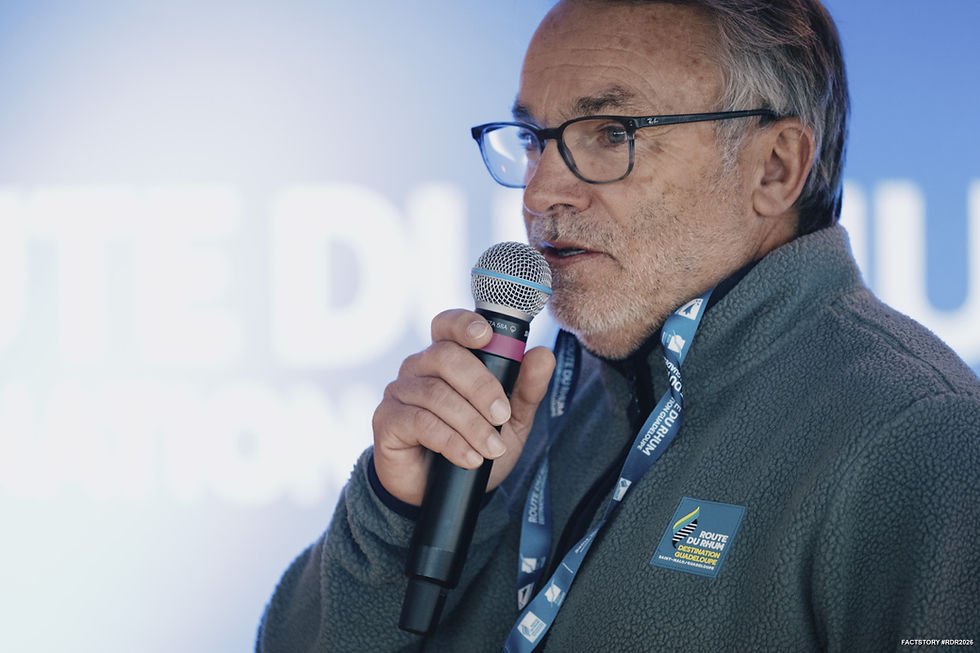

Francis Le Goff, Directeur de course de la Route du Rhum - Destination Guadeloupe. Crédit Vincent Curuchet


For Race Director Francis Le Goff, the outlook is pleasingly favourable: moderate seas, goFollowing the high winds of the past few days, how are the final preparations for the start shaping up? "We are now benefiting from a stable high-pressure system over the English Channel, which is expected to persist for several days. This is ideal for all port operations. Conditions are now similar to those we saw when the boats first docked in to the basins. The ULTIMs and IMOCAs will wait near Dinard, the Ocean Fifty fleet at the Bas Sablons harbor, while the Class40s will pass through the locks on Sunday morning. Skippers who have already moved their boats out can spend their final night on land, while their shore teams keep watch over the boats. Most importantly, we don’t have to worry about postponing or altering any plans. After such a turbulent week, it’s a relief to be able to carry out operations exactly as scheduled!"


In this context, how will spectators be able to follow the start from the water? "We are setting up two designated spectator zones—one off Pointe du Grouin and the other off Cap Fréhel—specifically to accommodate passenger excursion boats." However, spectators will need to choose a specific viewing area, as it will not be possible to follow the competitors as closely as in some previous editions. With favourable downwind conditions forecast, the multihulls will likely need to tack or jibe—sailing at angles to the wind—to make efficient progress. Consequently, spectator boats will not be able to accompany the fleet as it heads north. Instead, everyone will remain in their chosen zone—either to watch the start or to see the boats pass by Cap Fréhel. This approach ensures excellent viewing conditions while maintaining safety on the water.”


And what about the weather—what kind of scenario is shaping up for the start? “Honestly, it’s looking very good. We’re expecting winds of around 12 knots, relatively calm seas, and, most importantly, downwind conditions. It’s an ideal setup for the start of a transatlantic race. The wind is expected to gradually pick up overnight, reaching 18 to 20 knots. This will allow the boats to clear the English Channel quite quickly, without needing to hug the coastline or spend too much time navigating through heavy maritime traffic. It’s a fairly comfortable start, with enough pressure building afterward to really get some good speed going.”
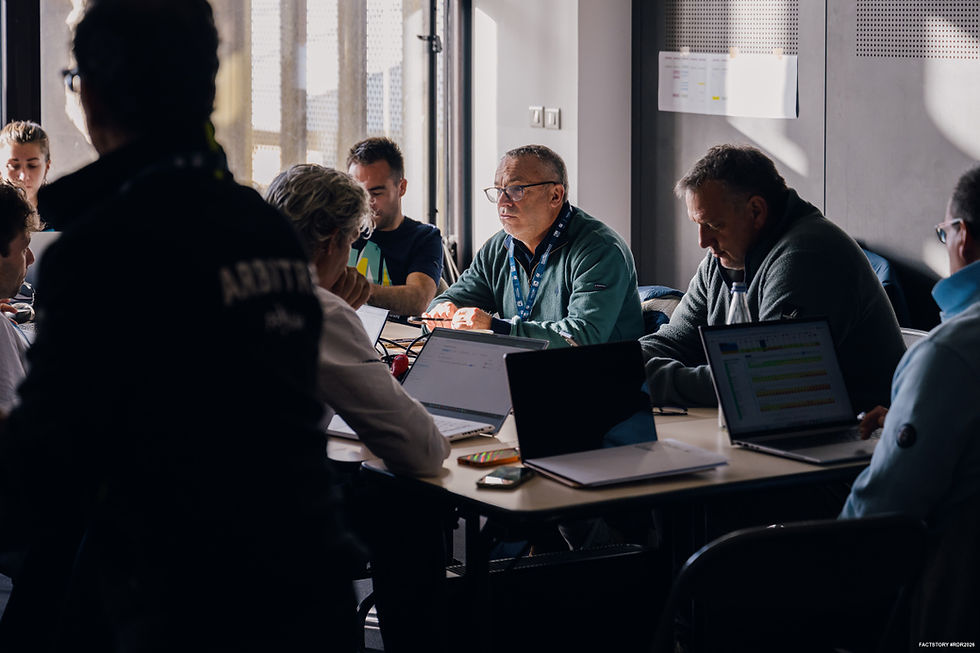


Bureau de la Direction de course. Crédit : Jean-Louis Carli

And looking just a bit further ahead, do things continue to look positive? “For the first 48 hours—and even a little beyond—there are no particular red flags. Looking at the 96-hour forecast, there are no major meteorological challenges on the horizon. The skippers should be able to get straight into the heart of the race without having to spend their first few days dealing with heavy weather. They’ll be able to focus on their strategic choices and performance. In short—it’s time for pure racing!”


The routing models favor courses well to the north. Should we expect the fleet to largely steer clear of the Bay of Biscay?

"Yes, that’s quite notable. Current scenarios have the boats passing very far to the north, following routes that could be relatively direct. It looks like we won’t be hearing much about the Bay of Biscay this year! Of course, each class will have its own options, and the trajectories will evolve as the forecasts are updated."


Could this lead to several records being broken?

"That’s entirely possible! If the current situation holds, all the ‘professional’ classes could aim for the race record in their respective categories. The routing projections are promising, with the potential for some very high-mileage days—especially overnight from Monday to Tuesday. We could see some record-shattering numbers! That said, there remains a significant degree of uncertainty regarding the final stretch, as the trade winds aren't very well established. It will be interesting to see how the competitors handle their approach to Guadeloupe. But on paper, the prospects look excellent."


For the ULTIM class, initial estimates point to a truly express crossing. Just how fast could it be?

"As of now, some routing models are indeed suggesting potential arrivals as early as the following Saturday—that’s around six days. Five days—I don’t think that’s feasible. But beating the current record? Yes, that’s definitely possible.”

Does this weather forecast take away much of the usual pressure experienced in the final hours?

“Yes, absolutely. It’s a relief not to have to deal with major uncertainty on the eve of the start. The sailors can focus on their preparations, the teams on their final tasks, and we can concentrate on overall coordination. The public will also be able to enjoy the event under great conditions. All of this makes for a much calmer atmosphere—there’s no need to wonder, right up until the last minute, whether the schedule will have to be changed.”


Still, with 115 boats charging across the Atlantic at full speed, in Race Direction you can’t exactly let your guard down…

“Certainly not! In fact, this kind of weather encourages skippers to push their machines to the limit. It remains a mechanical sport, where boats are put under immense strain; there’s always a risk of equipment failure, not to mention all the challenges that come with solo sailing. We’ll have 115 competitors out at sea, spread across very different classes. We have to stay on high alert to ensure everything goes smoothly for everyone, from the first boat to the last. The conditions are excellent for the start of this edition, but that doesn’t change our level of vigilance one bit.”

Oct 31
4 min read

On the eve of the start of the Route du Rhum – Destination Guadeloupe, scheduled for tomorrow Sunday at 1302hrs local time, final preparations are underway in Saint-Malo. Following the ULTIMs on Friday evening, the Ocean Fifty, IMOCA, and Vintage class boats will leave the harbor basins today Saturday, with the Class40s set to follow early on race day, tomorrow morning. It is a well-oiled process, made easier the settled, calm weather that has prevailed since the village was buffeted by series of low-pressure systems including passage of Storm Austen.


For Race Director Francis Le Goff, the outlook is pleasingly favourable: moderate seas, good (downwind) conditions, a quick exit from the English Channel, and a northerly (shorter) route that could pave the way for exceptionally fast crossing times.


Francis Le Goff, Directeur de course de la Route du Rhum - Destination Guadeloupe. Crédit Vincent Curuchet


For Race Director Francis Le Goff, the outlook is pleasingly favourable: moderate seas, goFollowing the high winds of the past few days, how are the final preparations for the start shaping up? "We are now benefiting from a stable high-pressure system over the English Channel, which is expected to persist for several days. This is ideal for all port operations. Conditions are now similar to those we saw when the boats first docked in to the basins. The ULTIMs and IMOCAs will wait near Dinard, the Ocean Fifty fleet at the Bas Sablons harbor, while the Class40s will pass through the locks on Sunday morning. Skippers who have already moved their boats out can spend their final night on land, while their shore teams keep watch over the boats. Most importantly, we don’t have to worry about postponing or altering any plans. After such a turbulent week, it’s a relief to be able to carry out operations exactly as scheduled!"


In this context, how will spectators be able to follow the start from the water? "We are setting up two designated spectator zones—one off Pointe du Grouin and the other off Cap Fréhel—specifically to accommodate passenger excursion boats." However, spectators will need to choose a specific viewing area, as it will not be possible to follow the competitors as closely as in some previous editions. With favourable downwind conditions forecast, the multihulls will likely need to tack or jibe—sailing at angles to the wind—to make efficient progress. Consequently, spectator boats will not be able to accompany the fleet as it heads north. Instead, everyone will remain in their chosen zone—either to watch the start or to see the boats pass by Cap Fréhel. This approach ensures excellent viewing conditions while maintaining safety on the water.”


And what about the weather—what kind of scenario is shaping up for the start? “Honestly, it’s looking very good. We’re expecting winds of around 12 knots, relatively calm seas, and, most importantly, downwind conditions. It’s an ideal setup for the start of a transatlantic race. The wind is expected to gradually pick up overnight, reaching 18 to 20 knots. This will allow the boats to clear the English Channel quite quickly, without needing to hug the coastline or spend too much time navigating through heavy maritime traffic. It’s a fairly comfortable start, with enough pressure building afterward to really get some good speed going.”


Bureau de la Direction de course. Crédit : Jean-Louis Carli

And looking just a bit further ahead, do things continue to look positive? “For the first 48 hours—and even a little beyond—there are no particular red flags. Looking at the 96-hour forecast, there are no major meteorological challenges on the horizon. The skippers should be able to get straight into the heart of the race without having to spend their first few days dealing with heavy weather. They’ll be able to focus on their strategic choices and performance. In short—it’s time for pure racing!”


The routing models favor courses well to the north. Should we expect the fleet to largely steer clear of the Bay of Biscay?

"Yes, that’s quite notable. Current scenarios have the boats passing very far to the north, following routes that could be relatively direct. It looks like we won’t be hearing much about the Bay of Biscay this year! Of course, each class will have its own options, and the trajectories will evolve as the forecasts are updated."


Could this lead to several records being broken?

"That’s entirely possible! If the current situation holds, all the ‘professional’ classes could aim for the race record in their respective categories. The routing projections are promising, with the potential for some very high-mileage days—especially overnight from Monday to Tuesday. We could see some record-shattering numbers! That said, there remains a significant degree of uncertainty regarding the final stretch, as the trade winds aren't very well established. It will be interesting to see how the competitors handle their approach to Guadeloupe. But on paper, the prospects look excellent."


For the ULTIM class, initial estimates point to a truly express crossing. Just how fast could it be?

"As of now, some routing models are indeed suggesting potential arrivals as early as the following Saturday—that’s around six days. Five days—I don’t think that’s feasible. But beating the current record? Yes, that’s definitely possible.”

Does this weather forecast take away much of the usual pressure experienced in the final hours?

“Yes, absolutely. It’s a relief not to have to deal with major uncertainty on the eve of the start. The sailors can focus on their preparations, the teams on their final tasks, and we can concentrate on overall coordination. The public will also be able to enjoy the event under great conditions. All of this makes for a much calmer atmosphere—there’s no need to wonder, right up until the last minute, whether the schedule will have to be changed.”


Still, with 115 boats charging across the Atlantic at full speed, in Race Direction you can’t exactly let your guard down…

“Certainly not! In fact, this kind of weather encourages skippers to push their machines to the limit. It remains a mechanical sport, where boats are put under immense strain; there’s always a risk of equipment failure, not to mention all the challenges that come with solo sailing. We’ll have 115 competitors out at sea, spread across very different classes. We have to stay on high alert to ensure everything goes smoothly for everyone, from the first boat to the last. The conditions are excellent for the start of this edition, but that doesn’t change our level of vigilance one bit.”


bottom of page