
A slim silhouette, white polo shirt, clean shaven, youthful face and the deep blue eyes, Tom Laperche emerged from the water like an vision. in front of a packed Memorial Act and on official pontoon ready to sink. Everyone wanted to be there this evening to share the first moments on land of the new prince of the oceans who clearly enjoyed looking back at length on his epic victory
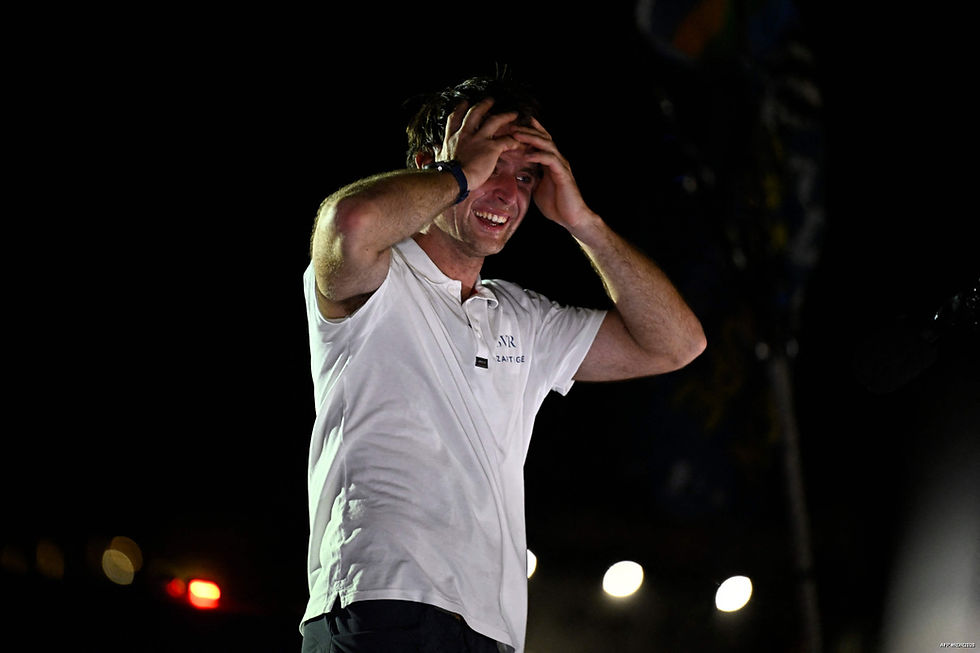
And straight after the first emotional moments on the pontoon and the media scrum came the sheer thrill of lifting the Route du Rhum-Destination Guadeloupe trophy aloft, overhead on the main stage.
Here are the first remarks from Laperche someone who tonight is thoroughly fulfilled.
His emotions upon arrival: “It’s the culmination of my entire life’s journey, ever since my childhood in La Trinité-sur-Mer. For decades, I’ve watched incredible footage of great champions arriving here. My dream was, first, to one day sail these boats—perhaps even solo—and, why not, to compete in the Route du Rhum. So, to win it at the helm of the most magnificent boat in the 2026 fleet—that makes me very, very happy.”
“With every gust, with every sail change, I was in complete fusion with the boat.”
The joy of being at sea: “I knew it wouldn’t be easy. No one ever wins the Route du Rhum by just coasting along. But I loved it; I found everything I had hoped for aboard this trimaran, SVR-Lazartigue high-speed performance and the sense that everything was unfolding with remarkable fluidity. With every gust, with every sail change, I was in complete fusion with the boat. I wanted this vessel to fly, to go as fast as it possibly could. At times, that’s all it wants to do—and it’s a joy to try and match its pace. I was in a state of grace. In my life, there have been two or three moments where everything just clicked, where it felt like nothing could go wrong: during the Solitaire du Figaro (2022) and at the start of the Arkéa Ultim Challenge-Brest (2024).”
The pivotal role of his team. “I had an extraordinary technical team that worked incredibly hard. Over the last five years, they did everything possible to ensure we could perform at the highest level. It’s clear that we’ve made tremendous progress.
I may have been alone at sea, but I can tell you that the team back on shore did an extraordinary job.”
An atypical race. “It’s true that the weather conditions were rather unusual. There were no trade winds, which forced us to take a more northerly route. I briefly exchanged messages with Charles Caudrelier, who remarked that this wasn’t an easy edition. We certainly had to deal with frequent sail changes, transitions, adjustments, and very long, demanding maneuvers. It requires a great deal of energy and the constant ability to refocus. I loved being in the midst of these challenges—pushing myself, transcending my own capabilities, and reaching beyond limits I hadn’t even imagined… And I’m very happy that I took it one step at a time, without focusing too much on the victory.”
We experience emotions that are almost indescribable.
Armel’s capsize. “When you find out about something like that while alone in the middle of the ocean, it’s an intense, chilling experience—it truly makes your blood run cold. I didn’t quite know what to do, and I felt very unsettled before getting back to the race. My thoughts are with them (Team Banque Populaire). It’s a reminder that while this is an extraordinary sport, we are always operating right on the edge; these boats are exceptional, but we are constantly walking a fine line. We experience emotions that are almost indescribable—it’s a level of total commitment you don’t find anywhere else, and that’s what makes it so beautiful.” The role of family. “I was fortunate to have parents who took me out cruising; my father even competed in the Route du Rhum, finishing 4th in the Multi50 class here in 2010. It was a wonderful experience to later sail the boat back alongside him, spending days and nights at sea. You have to love being at one with nature—taking care of the boat, listening closely to both the machine and the elements, and charting the best possible course.”
His mentors. “I don’t think I could ever thank François Gabart enough for believing in me. He was convinced I was capable of handling these large boats long before I realized it myself—a huge thank you to him for that. Two other people who contributed significantly to my current level of mastery are Pascal Bidégorry and Franck Cammas. Franck was part of the routing team and supported me throughout those six days of racing. Together with him, the entire team gave everything to ensure I was performing at my absolute best.”
Any thoughts on what’s next? “Well, I haven’t won the Route du Rhum a second time yet (laughs)! Offshore racing has evolved tremendously, and there are still plenty of great challenges to take on. One thing I haven’t managed to do yet is complete a full circumnavigation of the globe in these types of boats. In our sport, that remains a major challenge.”