top of page

Speeds especially at the front of the packs are are high and demanding, leader Tom Laperche on SVR Lazartigue made 775 nautical miles in 24 hours, solo!


The second night on course to Guadeloupe has been high-octane despite the first few weather transitions. And major strategic choices are beginning to take shape, with a low-pressure system expected near the Azores that could reshuffle the deck.
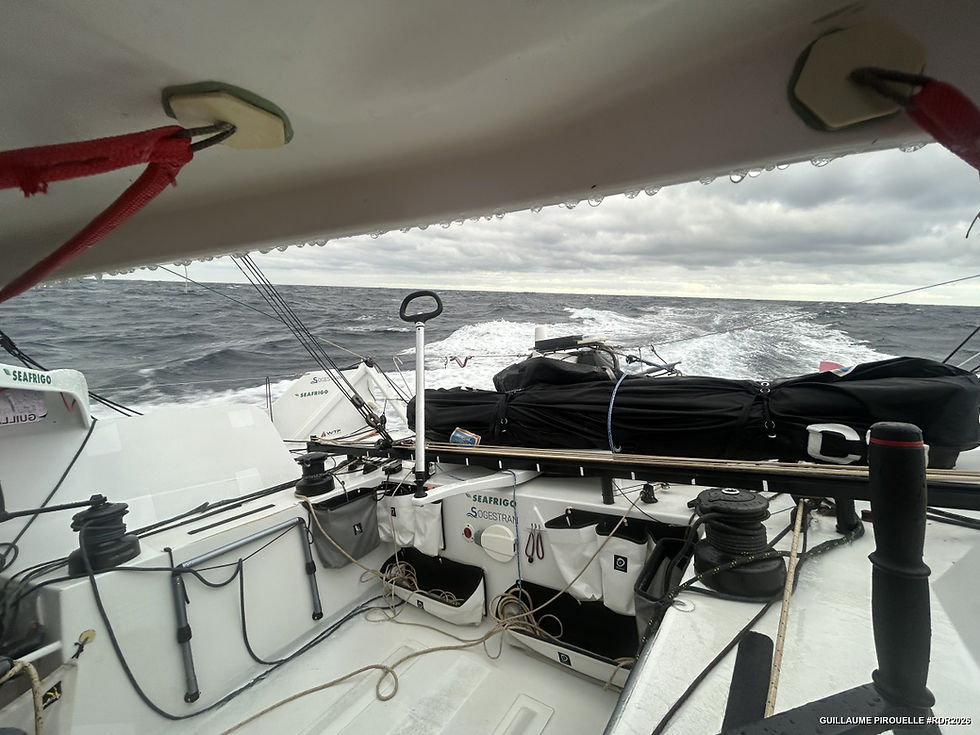

Crédit : Guillaume Pirouelle, skipper de Sogestran - Seafrigo


"The line between 'everything is going well' and 'everything is falling apart' is a very thin one."


In the early hours of this morning during the radio call with class leaders Sidney Gavignet, the hugely experienced skipper of the Vintage Mono class leader, Cigar Rouge, succinctly summed up life for the skippers racing solo to Guadeloupe on the second night,  "The line between 'everything is going well' and 'everything is falling apart' is a very thin one."


Speeds remain high, life on board tough. “We live like animals” grimaced Spanish Class 40 skipper Pep Costa from the depths of a dark night on VSF Sports. After two exceptionally fast days, the six fleets continue their progress toward the southwest, each with its own specific challenges and ambitions. But raw speed might now take second place to strategic choices


Ultim and Ocean Fifty: mind-boggling numbers Among the Ultims, the miles are racking up faster than cups of coffee in a newsroom on election night. Race leader Tom Laperche (SVR-Lazartigue) has covered 775 miles in the last 24 hours racing solo! This morning he is approaching the Azores and is set to pass about a hundred miles east of Corvo, the smallest island in the Portuguese archipelago.

In his wake, the other leading Ultims have also maintained impressive speeds, even while working through a trough between 2200hrs  and midnight. The passage of small front saw speeds drop momentarily from 35 to 25 knots, meaning a series of maneuvers. Armel Le Cléac'h (Maxi Banque Populaire XI) explains: "We crossed a weak front, but there was a fairly sharp transition between the southerly and northerly winds. There was quite a bit of work to do, and on these boats, that’s always very energy-intensive. Since then, the wind has picked up. We’re sailing downwind at around 30–35 knots, with a chaotic, multidirectional sea state. It’s not exactly comfortable!" 

Then, reported this morning, a serious setback for Charles Caudrelier and the new Gitana 18. Shortly before 0500hrs  this Tuesday, the skipper—who was in fourth place, roughly 400 miles north of the Azores—reported significant damage to his port-side foil. He is safe, and the situation is under control. Assisted by his shore team, he is working to secure the damaged foil and assess the extent of the damage, while his routing team evaluates the options for the next steps.

The gaps between the leading Ultims remain narrow but changes could be on the horizon. Two main options are emerging: executing a series of gybes in the north-northeasterly flow, or cutting across a high-pressure ridge—risking a temporary loss of ground—to reach better wind further to the west. Armel explains, "We’re waiting for the latest weather models to update our scenarios. One thing is certain: it won’t be a straight shot to the Antilles. There are still transitions and shifting winds ahead, along with moments where we’ll have to slow down significantly. Up until now, it’s mostly been about pure speed. It is much more uncertain." 


The Ocean Fifty fleet is certainly keeping up a blistering pace. The spectacular top speed recorded by Basile Bourgnon (Edenred) between Sunday night and Monday morning offers a glimpse into the speeds these 50-foot trimarans can reach. He reported this morning"To give those on land an idea, it feels like driving over gravel. It’s moving so fast that everything vibrates. When I saw the figure 43.1 knots pop up, it made me smile—though, in the moment, I wasn't feeling particularly flash; it was night, I couldn't see a thing, and I had no idea where I might end up!"


Since then, the pace has remained intense, yet the young skipper has managed to get some rest without easing off—thanks in part to the ergonomic design choices made inside Edenred to make life on board easier. The next challenge: that small front that the Ultim fleet passed through last night. The Ocean Fifty and IMOCAs now in turn, have to contend with that wind shift of nearly 180 degrees.


IIMOCA and Class40: physically and mentally draining

In the IMOCA class it is Corentin Horeau (MACSF) who has taken the lead on the IMOCA which finished second on the Vendée Globe. In second Italy’s Ambrogio Beccaria (Allagrande MAPEI) is frustrated. Between a water leak in the stern of his boat and a broken stove, things are not all unicorns and rainbows, not least having lost out at the moment to the talented Horeau,

"Honestly, it’s tough! I’m starting to run into a few little problems ...rhythm issues. There are a few minor things to deal with. It’s nothing serious, but it consumes a lot of energy. Carrying out small repairs is no easy task.” After correcting a course that had veered too far south, he explains that he is struggling to get the best performance out of his vessel in the changeable winds.

“Right now, I’m kind of battling the boat. I’m having trouble keeping it moving well. The wind is extremely changeable. But I’m pushing hard to try and stop the gap from growing any further.” The prospect of soon reaching downwind sailing conditions, however, gives him reason to be optimistic.

Sam Goodchild (MACIF Santé Prévoyance) is third 20 miles behind but lined up to the north of Horeau and Beccaria, looking to a better transition of the trough ahead. Germany’s Boris Herrmann (Malizia 4) is up to sixth and Italian-American Francesca Clapcich (11th Hour Racing) is seventh.  

In the Class40 fleet, the tactical options in play are is striking; there is already a lateral spread of more than 260 miles between the most extreme routes. Some have opted for a more northerly path, while others have chosen to head further south—each skipper trying to anticipate where the best passage will open up as the situation evolves.


Pre race favourite Guillaume Pirouelle (Sogestran – Seafrigo) has chosen a middle course, aiming to pass north of the Azores. “At times, when you hit the right angle with the waves, everything just flows. Then, if the wind shifts a bit, you end up burying the bow—it’s quite a jolt! But there are also moments when the speedometer just keeps climbing while surfing down the waves. It’s actually pretty great!” said Pirouelle this morning, continuing "The weather files don't quite agree, and they change significantly with every new update. There’s this large low-pressure system with multiple centers, so it’s quite hard to tell what’s going to happen. We’ll just have to work with what we get and try to adapt to the latest information. I don’t think anyone knows for sure which way it’s going to move."


While it is Pierre Leboucher (Imagine Institute) who leads Class40, Italian Luca Rosetti (Macaferri Futura) has been holding on to the high speeds well in second just ahead of Pirouelle.

Meanwhile, compatriot Marco Guerra (Imagin'Act-Socomec) has reached dry land. Faced with keel issues, a leak, and electronic failures, the skipper has pulled into Port-la-Forêt for a technical stop’
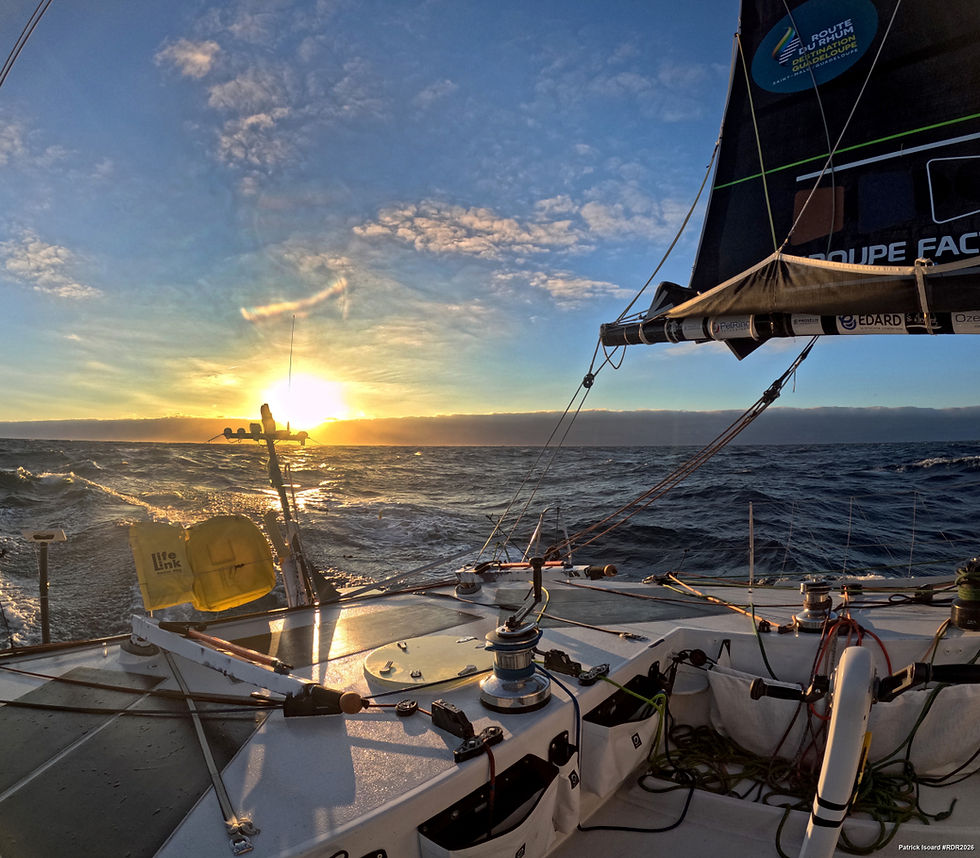

Crédit : Patrick Isoard, skipper de Groupe Cogedis pour Enfants du Mékong

Vintage: age and experience does not always mean no problems


In the Rhum Mono category, leader Sidney Gavignet (Le Cigare Rouge) had a night he could have easily done without. While sailing under a spinnaker in 25 to 30 knots of wind, his autopilot cut out. The boat veered off course, forcing him to react instantly. He had to take over the helm before  switching to the backup system before dropping the sail before things calmed down a bit. In the scramble, he even fell through a cockpit hatch that had been left open. The result: some bruised ribs and a major scare. The incident served as a reminder of the limitations of his older-generation monohull. "My boat isn't one that likes to be pushed hard. That was the mistake I made last night."  


Meanwhile, Ireland will be ready for two sailors arriving under very different circumstances. Anthony Marchand (Actual Ultim 4) is expected to arrive this afternoon, having damaged his central rudder after striking an external object—an incident that caused a critical jam in his steering system. Once in sheltered waters, his team will be able to carry out repairs before a decision is made regarding the future of his race. Francis Joyon (Vintage Multi Oceans) is also heading toward the Irish coast, though he is aboard the cargo ship Maersk Columbus, which rescued him around 2300hrs  on Monday following his capsize. The skipper is reported to be well and is expected to be brought ashore in the coming hours.


3 days ago
6 min read

Major damage has been reported to the port-side foil of the Maxi Edmond de Rothschild: Charles Caudrelier is safe and is currently working to secure his boat. After capsizing his ORMA 60 Francis Joyon safe on cargo ship heading for Ireland where he should arrive soon.


Speeds especially at the front of the packs are are high and demanding, leader Tom Laperche on SVR Lazartigue made 775 nautical miles in 24 hours, solo!


The second night on course to Guadeloupe has been high-octane despite the first few weather transitions. And major strategic choices are beginning to take shape, with a low-pressure system expected near the Azores that could reshuffle the deck.


Crédit : Guillaume Pirouelle, skipper de Sogestran - Seafrigo


"The line between 'everything is going well' and 'everything is falling apart' is a very thin one."


In the early hours of this morning during the radio call with class leaders Sidney Gavignet, the hugely experienced skipper of the Vintage Mono class leader, Cigar Rouge, succinctly summed up life for the skippers racing solo to Guadeloupe on the second night,  "The line between 'everything is going well' and 'everything is falling apart' is a very thin one."


Speeds remain high, life on board tough. “We live like animals” grimaced Spanish Class 40 skipper Pep Costa from the depths of a dark night on VSF Sports. After two exceptionally fast days, the six fleets continue their progress toward the southwest, each with its own specific challenges and ambitions. But raw speed might now take second place to strategic choices


Ultim and Ocean Fifty: mind-boggling numbers Among the Ultims, the miles are racking up faster than cups of coffee in a newsroom on election night. Race leader Tom Laperche (SVR-Lazartigue) has covered 775 miles in the last 24 hours racing solo! This morning he is approaching the Azores and is set to pass about a hundred miles east of Corvo, the smallest island in the Portuguese archipelago.

In his wake, the other leading Ultims have also maintained impressive speeds, even while working through a trough between 2200hrs  and midnight. The passage of small front saw speeds drop momentarily from 35 to 25 knots, meaning a series of maneuvers. Armel Le Cléac'h (Maxi Banque Populaire XI) explains: "We crossed a weak front, but there was a fairly sharp transition between the southerly and northerly winds. There was quite a bit of work to do, and on these boats, that’s always very energy-intensive. Since then, the wind has picked up. We’re sailing downwind at around 30–35 knots, with a chaotic, multidirectional sea state. It’s not exactly comfortable!" 

Then, reported this morning, a serious setback for Charles Caudrelier and the new Gitana 18. Shortly before 0500hrs  this Tuesday, the skipper—who was in fourth place, roughly 400 miles north of the Azores—reported significant damage to his port-side foil. He is safe, and the situation is under control. Assisted by his shore team, he is working to secure the damaged foil and assess the extent of the damage, while his routing team evaluates the options for the next steps.

The gaps between the leading Ultims remain narrow but changes could be on the horizon. Two main options are emerging: executing a series of gybes in the north-northeasterly flow, or cutting across a high-pressure ridge—risking a temporary loss of ground—to reach better wind further to the west. Armel explains, "We’re waiting for the latest weather models to update our scenarios. One thing is certain: it won’t be a straight shot to the Antilles. There are still transitions and shifting winds ahead, along with moments where we’ll have to slow down significantly. Up until now, it’s mostly been about pure speed. It is much more uncertain." 


The Ocean Fifty fleet is certainly keeping up a blistering pace. The spectacular top speed recorded by Basile Bourgnon (Edenred) between Sunday night and Monday morning offers a glimpse into the speeds these 50-foot trimarans can reach. He reported this morning"To give those on land an idea, it feels like driving over gravel. It’s moving so fast that everything vibrates. When I saw the figure 43.1 knots pop up, it made me smile—though, in the moment, I wasn't feeling particularly flash; it was night, I couldn't see a thing, and I had no idea where I might end up!"


Since then, the pace has remained intense, yet the young skipper has managed to get some rest without easing off—thanks in part to the ergonomic design choices made inside Edenred to make life on board easier. The next challenge: that small front that the Ultim fleet passed through last night. The Ocean Fifty and IMOCAs now in turn, have to contend with that wind shift of nearly 180 degrees.


IIMOCA and Class40: physically and mentally draining

In the IMOCA class it is Corentin Horeau (MACSF) who has taken the lead on the IMOCA which finished second on the Vendée Globe. In second Italy’s Ambrogio Beccaria (Allagrande MAPEI) is frustrated. Between a water leak in the stern of his boat and a broken stove, things are not all unicorns and rainbows, not least having lost out at the moment to the talented Horeau,

"Honestly, it’s tough! I’m starting to run into a few little problems ...rhythm issues. There are a few minor things to deal with. It’s nothing serious, but it consumes a lot of energy. Carrying out small repairs is no easy task.” After correcting a course that had veered too far south, he explains that he is struggling to get the best performance out of his vessel in the changeable winds.

“Right now, I’m kind of battling the boat. I’m having trouble keeping it moving well. The wind is extremely changeable. But I’m pushing hard to try and stop the gap from growing any further.” The prospect of soon reaching downwind sailing conditions, however, gives him reason to be optimistic.

Sam Goodchild (MACIF Santé Prévoyance) is third 20 miles behind but lined up to the north of Horeau and Beccaria, looking to a better transition of the trough ahead. Germany’s Boris Herrmann (Malizia 4) is up to sixth and Italian-American Francesca Clapcich (11th Hour Racing) is seventh.  

In the Class40 fleet, the tactical options in play are is striking; there is already a lateral spread of more than 260 miles between the most extreme routes. Some have opted for a more northerly path, while others have chosen to head further south—each skipper trying to anticipate where the best passage will open up as the situation evolves.


Pre race favourite Guillaume Pirouelle (Sogestran – Seafrigo) has chosen a middle course, aiming to pass north of the Azores. “At times, when you hit the right angle with the waves, everything just flows. Then, if the wind shifts a bit, you end up burying the bow—it’s quite a jolt! But there are also moments when the speedometer just keeps climbing while surfing down the waves. It’s actually pretty great!” said Pirouelle this morning, continuing "The weather files don't quite agree, and they change significantly with every new update. There’s this large low-pressure system with multiple centers, so it’s quite hard to tell what’s going to happen. We’ll just have to work with what we get and try to adapt to the latest information. I don’t think anyone knows for sure which way it’s going to move."


While it is Pierre Leboucher (Imagine Institute) who leads Class40, Italian Luca Rosetti (Macaferri Futura) has been holding on to the high speeds well in second just ahead of Pirouelle.

Meanwhile, compatriot Marco Guerra (Imagin'Act-Socomec) has reached dry land. Faced with keel issues, a leak, and electronic failures, the skipper has pulled into Port-la-Forêt for a technical stop’


Crédit : Patrick Isoard, skipper de Groupe Cogedis pour Enfants du Mékong

Vintage: age and experience does not always mean no problems


In the Rhum Mono category, leader Sidney Gavignet (Le Cigare Rouge) had a night he could have easily done without. While sailing under a spinnaker in 25 to 30 knots of wind, his autopilot cut out. The boat veered off course, forcing him to react instantly. He had to take over the helm before  switching to the backup system before dropping the sail before things calmed down a bit. In the scramble, he even fell through a cockpit hatch that had been left open. The result: some bruised ribs and a major scare. The incident served as a reminder of the limitations of his older-generation monohull. "My boat isn't one that likes to be pushed hard. That was the mistake I made last night."  


Meanwhile, Ireland will be ready for two sailors arriving under very different circumstances. Anthony Marchand (Actual Ultim 4) is expected to arrive this afternoon, having damaged his central rudder after striking an external object—an incident that caused a critical jam in his steering system. Once in sheltered waters, his team will be able to carry out repairs before a decision is made regarding the future of his race. Francis Joyon (Vintage Multi Oceans) is also heading toward the Irish coast, though he is aboard the cargo ship Maersk Columbus, which rescued him around 2300hrs  on Monday following his capsize. The skipper is reported to be well and is expected to be brought ashore in the coming hours.


bottom of page