

The demands of solo sailing are intense and continuous, every minute, every hour, every 24 hours. Five minutes before the start, the skipper becomes totally responsible for everything that happens on board. As the gun goes the skipper passes into a state of heightened, critical vigilance. With an eye always on the incoming weather and the helm and sheets at least close at hand, they must be ready to respond in a fraction of a second. By and large the level of risk between the monohulls and big multihulls is significantly different, not least because the multihulls are faster, they capsize and go upside down. For this reason, in the Route du Rhum - Destination Guadeloupe, skippers of ULTIM and Ocean Fifty multihulls are supported 24/7 from shore by groups of co-pilots known as "routers."
On Sunday, November 1st, as the 115 skippers set off on their oceanic sprint, there will be no respite—no time to eat or sleep, only the need to hold their course and navigate the initial hazards of the English Channel. Back on land, with eyes glued to weather data and charts, the router determines the most optimal route for the multihull sailors.
"If you compare it to Formula 1, we’re a bit like the engineers in the paddock—adjusting strategy, managing fuel, and timing tire changes," explains Yann Eliès, who will serve as the router for Anne-Claire Le Berre (Up Wind by Merconcept). "The skippers are completely focused, heads down, working to keep their boats moving well and staying upright."

A Matter of Survival
In a monohull, the level of commitment is just as intense, though the nature of the danger is different. Corentin Horeau, who races his IMOCA MACSF, sums it up perfectly: "In a monohull, you can’t capsize—unless the keel breaks. In terms of safety, you have time to look at the computer and manage the weather. Conversely, on ULTIMs or Ocean Fifty trimarans—which lack a keel and are more sensitive—there is a risk of capsizing the moment you fall asleep. You have to remain much more focused to avoid a capsize."
It is, therefore, primarily for safety reasons that external routing is permitted for these types of boats
As an ocean sprint the Route du Rhum is also the most intense event for these trimarans.
"I wouldn't go so far as to call the skippers 'warriors,'" says Yann Eliès, "but they certainly push things to the absolute limit."
So, why is it riskier during an Atlantic crossing? "In a round-the-world race, like the Arkéa Ultim Challenge—which is essentially a marathon—you could almost handle the routing yourself," explains Anthony Marchand (ACTUAL ULTIM 4). "But in a sprint like the Route du Rhum, routing is essential. You literally don't have a single minute to spare to spend in front of the computer."
In fact, the race isn't just decided in the opening days; it remains a factor throughout the entire 3,542-nautical-mile (6,559 km) course.
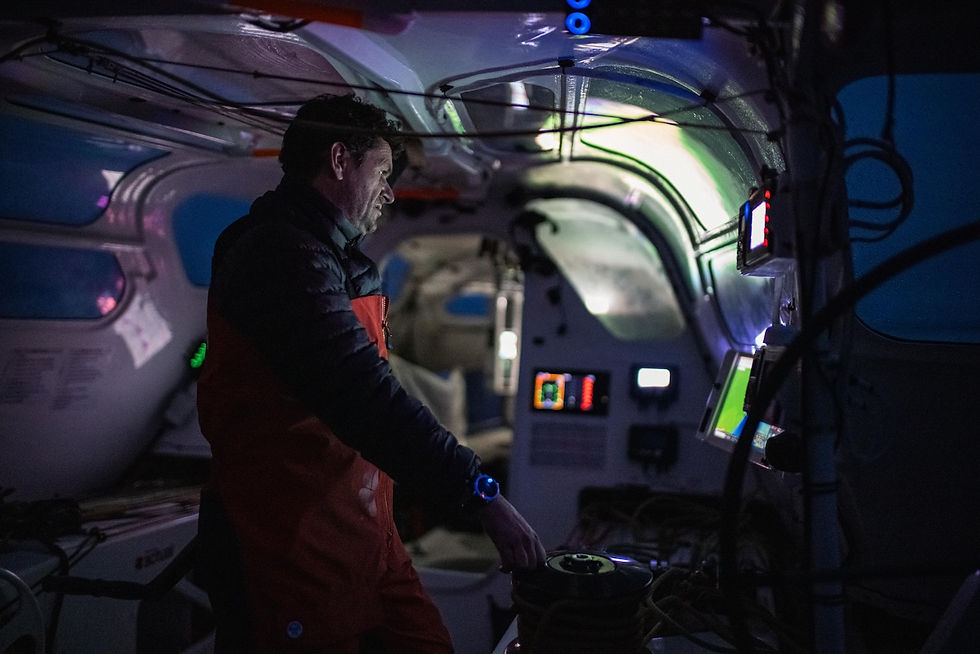
"When you run routing sessions," Marchand continues, "you spend at least two hours at the computer trying to analyze everything. Two hours at 40 knots covers 80 nautical miles—that’s nearly 150 kilometers traveled without once stepping outside." Even so, having 'co-skippers' on shore doesn't make everything simple; it is, above all, a matter of trust and a strong, collaborative rapport.
A matter of complete trust
"Being guided by a router is not as easy as it might seem," admits Anne-Claire Le Berre, who is using this system for the first time over such a long distance. "It’s a matter of finding the right balance between being directed from afar and keeping your own eyes on what’s happening around you." This delicate balance is only possible if a genuine rapport—a real chemistry—has developed between the skipper and their router. "During my first conversation with Yann (Eliès), he told me: 'I’ve never capsized a multihull, and I don’t intend for that to happen this year.' That certainly helps (laughs) and really sets the right foundation."
Assisting her, Yann Eliès will be joined by Justine Mettraux—both highly skilled offshore racers. For them, this is also an opportunity to hone their use of advanced tools and delve deeper into weather and strategic analysis—a luxury that is simply not possible once out at sea. Both routers are well-acquainted with both the sailor and her boat. "That’s the key," Anne-Claire asserts.
"To perform well, they need to have a comprehensive understanding of the sailor—their level of fatigue, what they are truly capable of," adds Erwan Le Draoulec (Lazare X Hellio). However, this does not mean the captain will follow the shore-based router’s instructions to the letter. "If a particular option seems unfeasible to us out on the water, we stick to our current course," Anne-Claire explains. "Ultimately, the final decision always rests with the person on board."
Protecting Both Human and Machine
In their strategic role, the router’s guiding principle is anticipation. For several years now, Christian Dumard has been widely recognized for his expertise in this field. For this edition, he will be working with Anthony Marchand, Alexia Barrier, and Guirec Soudé, assisted by his son Louis, who also “got swept up in it all.” “The task combines strategy,” Louis explains, “searching through various models, and constantly trying to find solutions and there is a strong human dimension: how the skipper is feeling, and whether they will be able to navigate through specific conditions.”
The athlete’s physical state matters just as much as the miles covered. “When a skipper is tired,” explains Christian Dumard, “they struggle to project themselves forward in time and space. It becomes difficult for them to think: ‘In eight hours, I’ll be at this spot, a front will be passing through, and I’ll need to reef the sails.’ On a Class40, you can reef ten minutes ahead of time—no problem. On an ULTIM, these maneuvers must be anticipated—or even carried out—several hours in advance. The goal is also to safeguard the skipper’s well-being and health.” Understanding a sailor’s physical and psychological state requires real nuance. “You have to be able to find the right words, to sense—through a written message or a spoken phrase—whether your skipper is doing okay,” notes Yann Eliès. “Do they need to go get some sleep? Have they eaten? You also need to be able to tell them: ‘It’s alright; we aren’t going to win the race this very second. Engage the autopilot, eat, get some sleep, and call me back in two hours.’”
Throughout the race, the router is also fully immersed, albeit from shore. But while they may plot the course and keep a watchful eye on safety, the skipper remains solely in charge of their boat and their ultimate destiny.