



Continuing to inspire and bring people together, while evolving its model: this is the ambition behind “Terres d’engagements”, the CSR strategy of the Route du Rhum – Destination Guadeloupe.
The strategy builds on the work undertaken by OC Sport for more than ten years to better integrate social and environmental issues into its events, an approach recently recognised through its international B Corp certification.
For its 13th edition, this commitment translates into new concrete initiatives in mobility, energy, ecosystem protection, accessibility and knowledge sharing. It is part of a continuous improvement trajectory developed with local authorities, partners and stakeholders in Saint-Malo and Guadeloupe, with the aim of balancing the sporting and popular appeal of the Route du Rhum with greater control over its impacts.

Doing better, without losing what makes the event so special
“Terres d’engagements” is part of an approach undertaken by OC Sport for more than ten years to evolve its practices and better integrate social and environmental issues into the organisation of its events. Structured around the “Beyond Sport, For Nature” CSR plan, this approach has, since 2021, notably been based on the systematic measurement of events’ carbon footprints and the implementation of reduction pathways. It reached a new milestone in September 2026 with OC Sport obtaining international B Corp certification.
For more than 40 years, the Route du Rhum has brought together skippers, enthusiasts, local residents and visitors every four years between Saint-Malo and Guadeloupe. This popular dimension is at the heart of the event’s identity. The challenge is therefore not simply to do more, but to progressively evolve its organisation while seeking a better balance between the event’s profile, the experience offered to audiences, and the management of its environmental and territorial impacts.
This ambition is reflected in a dedicated CSR strategy, “Terres d’engagements”, which structures the commitments of the Route du Rhum – Destination Guadeloupe 2026 around three complementary pillars: the Sustainable Pact, which aims to reduce the event’s environmental impact; the Territorial Pact, which seeks to strengthen its roots in the territories and among the people who bring them to life; and the Legacy Pact, which aims to preserve and pass on the heritage of the race. Together, these three pillars provide the framework for the CSR strategy and bring coherence to the initiatives rolled out from one edition to the next.
“Our objective is not to claim a perfect model, but to make progress with every edition. The Route du Rhum – Destination Guadeloupe must continue to inspire and bring people together, while finding the right balance between the emotions it creates, its reach and its development. This is also what will allow it to continue to be welcomed and shared 10 or 15 years from now. Sport has its own pace, and so does nature: this belief guides the way we evolve our events.”
Julie Coutts, Managing Director, OC Sport Pen Duick

Sustainable Pact: reducing impacts through concrete action
Mobility is one of the key areas of action for this edition, with priority given to rail travel, a particularly low-carbon mode of transport.
Thanks to SNCF, a partner of the 2026 edition, and in partnership with the Brittany Region, rail services on the Rennes–Saint-Malo and Paris–Saint-Malo routes will be strengthened, with 16 additional TER trains providing more frequent services and enabling the public to enjoy the Village and evening activities. In total, 280,000 TER seats will be available over the 13 days of the Village, while 15 additional TGV trains will run between Paris and Saint-Malo, providing 65,000 additional seats during the Village period.
At local level, Saint-Malo Agglomération will deploy a dedicated service on the MAT network throughout the event, with extended routes and timetables, five temporary lines connecting the towns within the agglomeration to the railway station, and two park-and-ride facilities served by shuttles to the Village. A dedicated shuttle for people with disabilities will complement the service. Public transport will also rely on the regional BreizhGo coach network.
An awareness campaign promoting collective and low-carbon mobility, particularly rail travel, carpooling and active mobility, will also be conducted with Mollow, a specialist media and agency. The electrification of mobility will be strengthened through the installation of 36 electric vehicle charging points. Race partner Suzuki Automobile will also contribute by providing the organisation with a fleet of 12 fully electric eVITARA vehicles at the start Village, which will welcome the public for 13 days.
Following several editions of gradual transformation, the Village will reach a major milestone in 2026: its connection to the electricity grid will enable all installations to operate without additional fossil-fuel-powered generators.
This development is supported in particular by investments made by the City of Saint-Malo and by the connection of the facilities to the public electricity distribution network by Enedis.
EDF, the event’s Official Supplier, is also supporting the Route du Rhum – Destination Guadeloupe in the electrification of the Village.
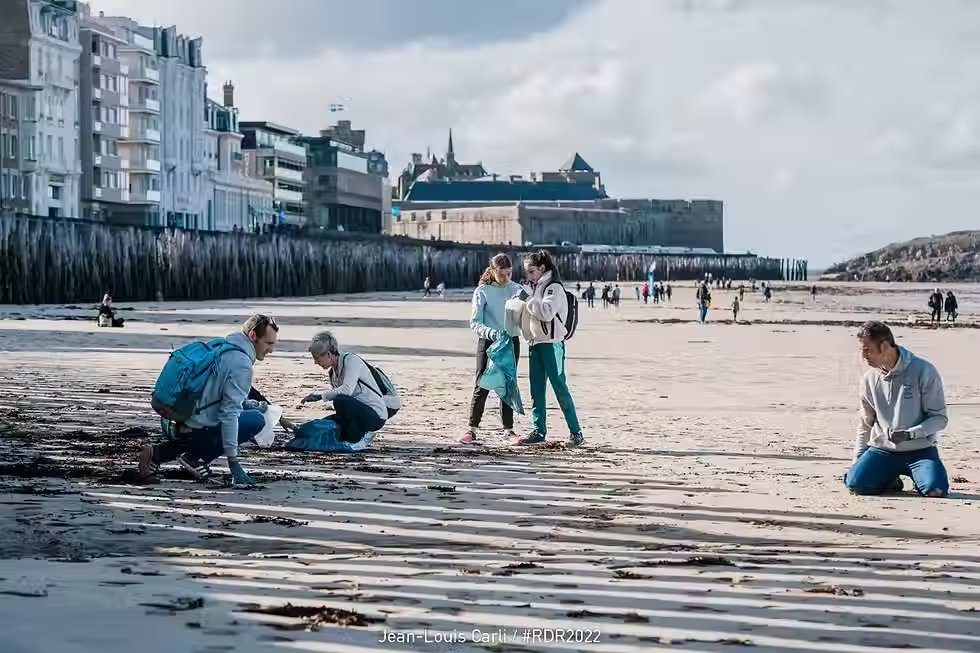
Waste reduction and recovery will also benefit from a strengthened programme in 2026. OC Sport Pen Duick, CITEO, the City of Saint-Malo, Saint-Malo Agglomération, La Petite Boucle – a local social and solidarity economy organisation – and Aremacs are working together, with joint governance of the issue across the Village.
The approach begins upstream, with eco-design and reuse principles incorporated into the exhibitors’ charter, and continues throughout the Village with harmonised collection systems and the inclusion of food waste, which will be recovered within a few dozen kilometres of Saint-Malo. For this edition, Aremacs’ presence will be strengthened and extended both before and after the Saint-Malo Village, in order to support waste collection and recovery over a longer period.
As part of the same approach, water fountains will also be installed with the support of 11th Hour Racing, which works with sailing and maritime communities to advance solutions that protect and restore ocean health, water fountains will also be installed to reduce reliance on single-use containers.
Beyond the Village, the preservation of marine and coastal ecosystems is another key area of focus. A new zero cargo return rule has been incorporated into the Notice of Race, while Cetacean Protection Zones (CPZs) are being established in collaboration with 11th Hour Racing. An “Ocean Day” will also be held on Friday 30 October with 11th Hour Racing, to raise public awareness of ocean preservation issues.
“The Route du Rhum – Destination Guadeloupe has an extraordinary ability to connect people around the world with the ocean, and with that reach comes an opportunity to lead by example. At 11th Hour Racing, we believe sustainability should be built into how major sporting events operate. From creating a cetacean protection zone with the Marine Mammal Advisory Group to reducing waste and single-use plastics in the race village and dedicating an entire day to ocean solutions, this partnership is about turning ambition into practical, measurable action. We are proud to work alongside the organizers, sailors, and communities to help protect the ocean that makes this iconic race possible.”
Jeremy Pochman, CEO and Co-Founder, 11th Hour Racing
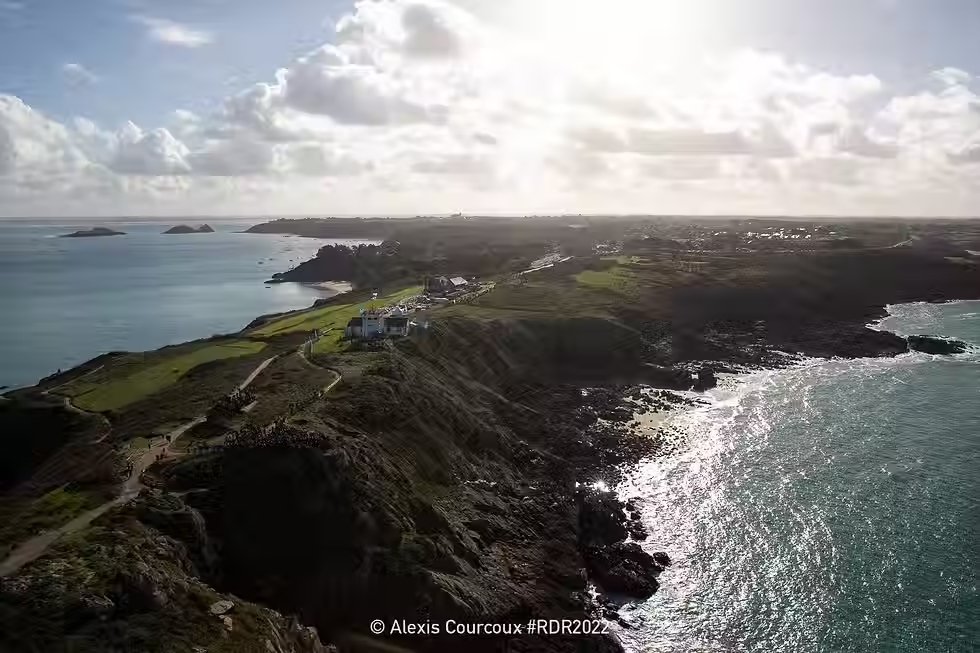
The preservation of Natura 2000 protected areas, from Pointe du Grouin to Cap Fréhel, is an important part of the event’s preparation and is subject to a dedicated programme.
Consultation is underway with local authorities and the managers of the areas concerned, including the Conservatoire du Littoral, the Departments, the DDTMs, site managers, the Grand Site de France Cap d’Erquy-Cap Fréhel and the Rance-Émeraude Regional Nature Park.
At the same time, a Natura 2000 Impact Assessment is being conducted with Biotope. Nearly 15 avoidance, reduction, monitoring and support measures are planned to identify and protect sensitive areas and adapt the event arrangements, particularly in terms of access and crowd management.
The objective is to prevent any degradation of these protected areas. If necessary, enhanced protection measures may be implemented, while ensuring that free public access is maintained as much as possible.
“This approach is not about simply adding up measures, but about progressively changing the way we design the event. In terms of mobility, energy, resources and ecosystem protection, we are moving forward with our partners by focusing on the levers we can genuinely influence. The objective is not to claim a perfect event, but to make progress with every edition, learn and do better.”
Stéphane Bourrut-Lacouture, CSR Manager, OC Sport
Territorial Pact: an event built with its territory, partners and audiences
In 2026, the Route du Rhum – Destination Guadeloupe is strengthening its local roots, with closer consultation between the organiser, local authorities and local stakeholders.
Territorial meetings and discussion sessions bring together economic, social, community and institutional stakeholders to prepare the event collectively, better share its challenges and enable the territory to take ownership of the event.
This dynamic begins well before the Village opens. The Route du Rhum – Destination Guadeloupe Trophy will travel through the towns of Saint-Malo Agglomération, stopping at town halls to meet residents and bring the event to life across the territory.
Another new feature in 2026 is the creation of the first Route du Rhum – Destination Guadeloupe Off Festival, with the ambition of extending the event beyond the quays and bringing it to a wider area.
Activities, meetings, exhibitions, concerts, street performances and events organised by local businesses will bring the Route du Rhum experience to different locations across Saint-Malo and its surrounding area.
The aim is also to create connections between the Village and town centres, inviting visitors to discover the area and, conversely, bringing the event closer to local residents, supporting the territory’s vitality and attractiveness.

This approach will also be central to the Village through “Terres de Départ”, a space dedicated to showcasing the territory, its stakeholders, expertise and local produce, as well as through the prominent role given to community organisations.
In 2026, 50 associations will be welcomed at the event, including Breton organisations such as Plankton Planet and Témoins Polaires, as well as the Guadeloupe-based organisation Capture and Release, illustrating the race’s roots in its territories.
Each day, from 3:00 to 4:00 p.m., a dedicated association slot will allow organisations supported by the skippers to present their activities and the causes they champion. These initiatives will help make the Village a space for awareness, dialogue and knowledge sharing.
Finally, inclusion is another important focus of the work carried out with local stakeholders. An Inclusion Day will be organised on 22 October with Café Joyeux.
As part of an initiative led by the City of Saint-Malo, a group of 20 volunteers taking part in a reintegration programme will also join the SNBSM teams during the event.
The “Hour Without Music”, a daily period without music or sound entertainment from 12:30 to 1:30 p.m., as well as sign-language interpretation during key events, a quiet area established by the City of Saint-Malo, and various measures facilitating access for people with reduced mobility will complete the programme.

Legacy Pact: preserving what makes the Route du Rhum unique, so it can be passed on
The selection of boats is based on a simple principle: promoting the longevity of existing boats and, for the most recent units, imposing increasingly demanding eco-design criteria depending on how recently they were launched.
Among the 28 boats entered in these two categories, 24 were launched before 2011, and none since 2022.
This commitment to passing on the race’s heritage will also be embodied in the heart of Saint-Malo through the free exhibition “La Route de la Victoire – Maquettes des bateaux de légende”, presented at the Chapelle de la Victoire in Intra-Muros.
Designed as a temporary Route du Rhum – Destination Guadeloupe museum in partnership with the City of Saint-Malo, the exhibition will retrace the major moments that have shaped the race’s legend, from its creation by Michel Etevenon to the victories of the sailors who have marked its history, through stories, previously unseen images and models of iconic boats.
This history will continue to live on beyond the 2026 edition: between editions, the Route du Rhum – Destination Guadeloupe Trophy will be exhibited at the Musée maritime de l’Hydro, extending this work of preserving and passing on the memory of the race.
More than simply a succession of initiatives, “Terres d’engagements” sets out a trajectory: that of an event that learns from every edition, draws on its partners and territories to make progress, and seeks, over time, to reconcile the intensity of a major popular race with greater control over its impacts.
Increased vigilance regarding water use
In the current context of drought alert in Ille-et-Vilaine, particular attention will be paid to water use.
Like all users and stakeholders in the area, the Route du Rhum – Destination Guadeloupe is subject to the restrictions in force under the prefectural drought order and intends to play its full part in the collective effort towards more responsible water use, in coordination with the City of Saint-Malo and the Brittany Region.
This vigilance will be accompanied by a dedicated information and awareness programme. Participants, exhibitors and caterers will be informed of the applicable restrictions and the best practices to follow.
The public will also be made aware of these issues before and during the event, through the eco-responsible visitor guide, social media and dedicated communications at the Village.
Key figures:
3 pillars structuring the “Terres d’engagements” strategy
100% of Village installations powered by the electricity grid
36 electric vehicle charging points and 12 fully electric vehicles deployed at the Village
Nearly 15 measures planned to protect Natura 2000 areas between Pointe du Grouin and Cap Fréhel
50 associations welcomed at the event
0 cargo returns for boats, a new rule incorporated into the Notice of Race
Useful links: