top of page

Strategies now really need to take safety into the equation. With sudden shifts in wind, uncertain routes, and challenging sea conditions, the leaders must look after themselves. Weather routing software might suggest the fastest path but a safety factor is always required setting limits of winds and sea states.
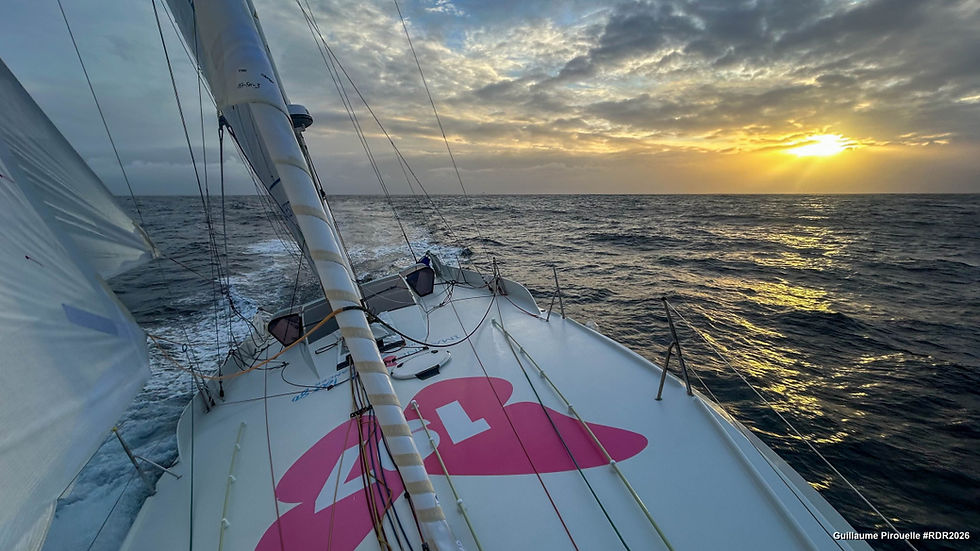

Crédit : Guillaume Pirouelle, skipper du Class40 Sogestran - Seafrigo

The trade winds are nowhere to be found. Shorts and T shirts are still buried at the bottom of the gear bag. Four days after departing from Saint-Malo, the Route du Rhum - Destination Guadeloupe is a meteorological puzzle. Between two low-pressure systems, unpredictable squalls, and the need to constantly re-evaluate the routes is essential.


Speed limits

After being rescued from the capsized Maxi Banque Populaire XI on Wednesday afternoon Armel Le Cléac'h was rescued by a Panamanian cargo ship heading for the USA. It is a massive relief in an edition of the race which has been mentally and physically tough on the skippers.

In the Ultim fleet, Tom Laperche (SVR-Lazartigue) continues to hold a comfortable lead. Next he has to  be very cautious. This Thursday evening he will get into stormy low-pressure system in the northeast of the Greater Antilles – Cuba, Puerto Rico and Jamaica. Tomorrow he will need to slip south of the system before beating upwind toward Guadeloupe, working through rough, chaotic seas. It will be massively unpredictable. "I’ve never sailed through this type of depression before. I’ll have to find the right balance between the theoretically optimal route and what is actually feasible out on the water. The boat wants to go fast—you have to let it run—but not too fast! It’s a matter of fine-tuning, right down to the choice of sails. Above all, you have to avoid being over-canvassed. Sometimes you find yourself a bit under-canvassed, which is frustrating, but when you have a safety margin, it’s easier to accept. Two days from the finish, I’m still wearing a down jacket, foul-weather trousers, and boots!" The brochure promised the Caribbean, but instead Laperched has ended up with weather more typical of the Irish Sea.


Big squalls

Further east, the low-pressure system near the Azores has already begun to hit the leading IMOCA and Ocean Fifty boats. Leader Corentin Horeau got by his first big squall at 4:30 this morning: "I just got hit by a  violent squall! The wind went from 8 to 40 knots in fifteen seconds. I wasn't expecting it at all. I had to bear away and run downwind just to furl my headsail." "Fortunately, I didn't break anything." But the skipper of MACSF also had to contend with patches of light wind, while Boris errmann (Malizia 4) has had more favorable conditions and has managed to close some 90 or so miles of the gap. Yesterday MACSF had built a lead of up to 230 miles this morning that is more like an 145-mile advantage. Now as the wind picks up, the challenge will be to maintain a steady pace. "The trouble with these boats is that even when you want to slow down, you can't always manage it!" concluded Horeau
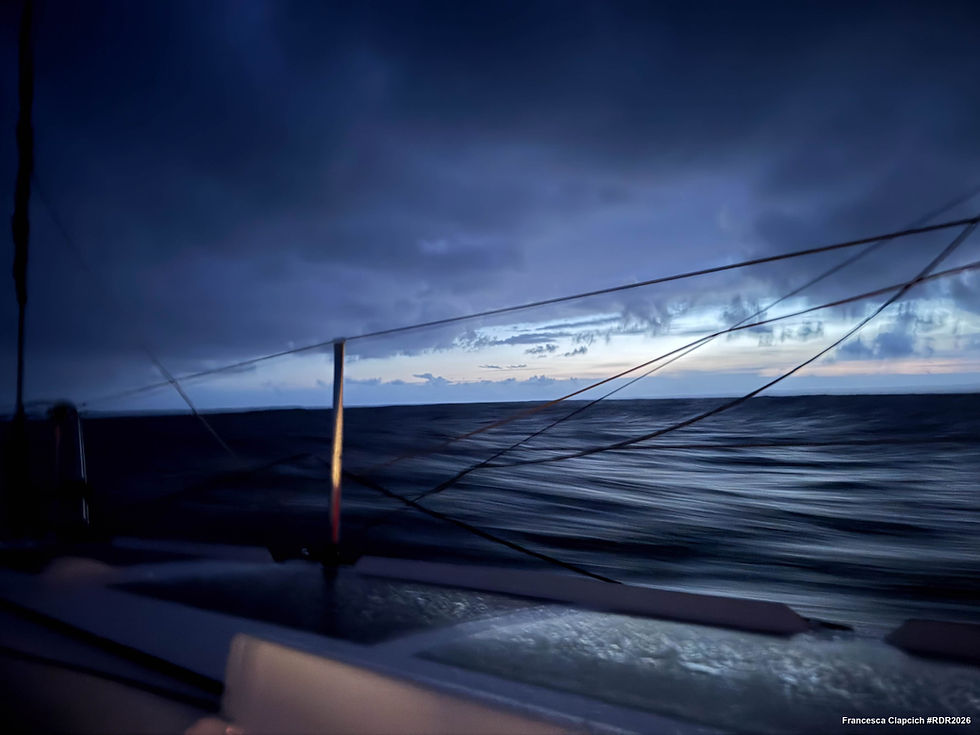


Crédit : Francesca Clapcich, skipper de l'IMOCA 11th Hour Racing

Smallest sails

As for Ocean Fifty leader Basile Bourgnon (Edenred) it has been very tough, too "I’m running just about the smallest sail area possible. It’s absolutely full-on! We’re seeing sustained winds of 30 knots behind the front, and in an Ocean Fifty, you don’t try to be a hero in these conditions. The goal isn't to go fast—it’s to get out of here without breaking any gear." And the most grueling part wasn't necessarily coming from the sky. "Now, I have to deal with the residual swell left behind by the front. It’s hitting us on the beam—it’s horrible. I can’t wait to get out of this area!" Tomorrow may bring a brief lull between weather systems for the leaders of both fleets. It’s a pause in the hostilities, certainly not a lasting peace treaty: conditions will deteriorate once again as they approach the Caribbean archipelago this weekend.

Among the Class40 fleet, Guillaume Pirouelle (Sogestran – Seafrigo) is enjoying relatively calm seas this Thursday. After navigating a windless transition zone, he has seen his pursuers benefit from more favorable conditions. "I had built up a bit of a lead, but the gaps have narrowed significantly. It’s never exactly pleasant, but it was to be expected It’s nice to be able to move around without having to hold onto something with every step, to eat better, and to sleep more soundly. But that’s going to change quickly." But tomorrow it will be the Class40s' turn to face that notorious low-pressure system northwest of the Azores. With sustained winds, sudden shifts in direction, and increasingly rough seas, they are in for a hard time. Depending on their position and the route they’ve chosen, the intensity of what they face will vary. "Near the center of the system, you have to stay on high alert. After that, we’re looking at a day and a half—maybe even two days—of difficult conditions."


The tropics are on hold.

For competitors in the Rhum Mono and Vintage Multi categories, the equation is different again. Widely scattered across the Atlantic, they must contend with weather systems that will evolve as they progress. Four days after leaving Saint-Malo, Mathieu Claveau (Inherent – ​​Phare 40) and Stéphane Bodin (Wasabiii) are still sailing at the same latitude as the Saint Malo The two Class40s have covered plenty of miles and performed numerous maneuvers, yet they have made hardly any progress southward. It would be hard to find a better illustration of a transatlantic race deprived of its usual trade winds. And judging by what is taking shape on the weather charts, this Route du Rhum - Destination Guadeloupe clearly has a few more surprises in store.

9 hours ago
4 min read

Two low chaotic pressure systems are affecting the fleets. The IMOCA and Ocean Fifty classes are already dealing with the effects of a weather system near the Azores, which is expected to hit the Class40 fleet even harder on Friday. Further ahead, the Ultim trimarans must deal with another disturbance—a tropical storm—as they approach the French Caribbean Islands

Strategies now really need to take safety into the equation. With sudden shifts in wind, uncertain routes, and challenging sea conditions, the leaders must look after themselves. Weather routing software might suggest the fastest path but a safety factor is always required setting limits of winds and sea states.


Crédit : Guillaume Pirouelle, skipper du Class40 Sogestran - Seafrigo

The trade winds are nowhere to be found. Shorts and T shirts are still buried at the bottom of the gear bag. Four days after departing from Saint-Malo, the Route du Rhum - Destination Guadeloupe is a meteorological puzzle. Between two low-pressure systems, unpredictable squalls, and the need to constantly re-evaluate the routes is essential.


Speed limits

After being rescued from the capsized Maxi Banque Populaire XI on Wednesday afternoon Armel Le Cléac'h was rescued by a Panamanian cargo ship heading for the USA. It is a massive relief in an edition of the race which has been mentally and physically tough on the skippers.

In the Ultim fleet, Tom Laperche (SVR-Lazartigue) continues to hold a comfortable lead. Next he has to  be very cautious. This Thursday evening he will get into stormy low-pressure system in the northeast of the Greater Antilles – Cuba, Puerto Rico and Jamaica. Tomorrow he will need to slip south of the system before beating upwind toward Guadeloupe, working through rough, chaotic seas. It will be massively unpredictable. "I’ve never sailed through this type of depression before. I’ll have to find the right balance between the theoretically optimal route and what is actually feasible out on the water. The boat wants to go fast—you have to let it run—but not too fast! It’s a matter of fine-tuning, right down to the choice of sails. Above all, you have to avoid being over-canvassed. Sometimes you find yourself a bit under-canvassed, which is frustrating, but when you have a safety margin, it’s easier to accept. Two days from the finish, I’m still wearing a down jacket, foul-weather trousers, and boots!" The brochure promised the Caribbean, but instead Laperched has ended up with weather more typical of the Irish Sea.


Big squalls

Further east, the low-pressure system near the Azores has already begun to hit the leading IMOCA and Ocean Fifty boats. Leader Corentin Horeau got by his first big squall at 4:30 this morning: "I just got hit by a  violent squall! The wind went from 8 to 40 knots in fifteen seconds. I wasn't expecting it at all. I had to bear away and run downwind just to furl my headsail." "Fortunately, I didn't break anything." But the skipper of MACSF also had to contend with patches of light wind, while Boris errmann (Malizia 4) has had more favorable conditions and has managed to close some 90 or so miles of the gap. Yesterday MACSF had built a lead of up to 230 miles this morning that is more like an 145-mile advantage. Now as the wind picks up, the challenge will be to maintain a steady pace. "The trouble with these boats is that even when you want to slow down, you can't always manage it!" concluded Horeau


Crédit : Francesca Clapcich, skipper de l'IMOCA 11th Hour Racing

Smallest sails

As for Ocean Fifty leader Basile Bourgnon (Edenred) it has been very tough, too "I’m running just about the smallest sail area possible. It’s absolutely full-on! We’re seeing sustained winds of 30 knots behind the front, and in an Ocean Fifty, you don’t try to be a hero in these conditions. The goal isn't to go fast—it’s to get out of here without breaking any gear." And the most grueling part wasn't necessarily coming from the sky. "Now, I have to deal with the residual swell left behind by the front. It’s hitting us on the beam—it’s horrible. I can’t wait to get out of this area!" Tomorrow may bring a brief lull between weather systems for the leaders of both fleets. It’s a pause in the hostilities, certainly not a lasting peace treaty: conditions will deteriorate once again as they approach the Caribbean archipelago this weekend.

Among the Class40 fleet, Guillaume Pirouelle (Sogestran – Seafrigo) is enjoying relatively calm seas this Thursday. After navigating a windless transition zone, he has seen his pursuers benefit from more favorable conditions. "I had built up a bit of a lead, but the gaps have narrowed significantly. It’s never exactly pleasant, but it was to be expected It’s nice to be able to move around without having to hold onto something with every step, to eat better, and to sleep more soundly. But that’s going to change quickly." But tomorrow it will be the Class40s' turn to face that notorious low-pressure system northwest of the Azores. With sustained winds, sudden shifts in direction, and increasingly rough seas, they are in for a hard time. Depending on their position and the route they’ve chosen, the intensity of what they face will vary. "Near the center of the system, you have to stay on high alert. After that, we’re looking at a day and a half—maybe even two days—of difficult conditions."


The tropics are on hold.

For competitors in the Rhum Mono and Vintage Multi categories, the equation is different again. Widely scattered across the Atlantic, they must contend with weather systems that will evolve as they progress. Four days after leaving Saint-Malo, Mathieu Claveau (Inherent – ​​Phare 40) and Stéphane Bodin (Wasabiii) are still sailing at the same latitude as the Saint Malo The two Class40s have covered plenty of miles and performed numerous maneuvers, yet they have made hardly any progress southward. It would be hard to find a better illustration of a transatlantic race deprived of its usual trade winds. And judging by what is taking shape on the weather charts, this Route du Rhum - Destination Guadeloupe clearly has a few more surprises in store.


bottom of page