top of page

For the "Vintage Mono" class, it’s all about history, and the stories that they bring! While other classes in the Route du Rhum-Destination Guadeloupe have to adhere to strict measurement rules to level the playing field and crown the best skipper, the Vintage Mono class takes a different view.


Here in a fleet of 13 diverse boats the focus is on adventure. The boats range from 12 to 26 meters but which are still classified according to their real time finishing order.

In keeping with the abiding ethos of this historic Transatlantic sprint from Saint Malo to Guadeloupe, which takes place only every four years, you’ll find a lively mix of professional and amateur sailors, a wonderful blend of generations. This remains a class that really resonates with the public!


The 20th century rocks


The 1994 edition of the Route du Rhum was the first to rank multihulls and monohulls separately. Before that the race had a rather rocky relationship between the two.  Canadian Mike Birch won the first-ever Route du Rhum in 1978 aboard his yellow trimaran Olympus Photo, beating Michel Malinovsky's large monohull Kriter V by just 98 seconds after a 23-day Atlantic crossing.

Some would say Malinovsky did not learn his lesson. In 1982, he returned with the radical Kriter VIII—a long, 23-meter aluminium "cigar"—and finished 10th. That philosophical rivalry between Mono and Multi contest was effectively over. Just like stereo took over from mono, so multihulls prevailed in terms of raw speed on the Transatlantic routes. Monohulls would have to wait until the first Vendée Globe in 1990 for their revival.

These transitional years sparked a flurry of architectural experimentation, including 50- and 60-foot classes, an aborted attempt at a one-design round-the-world race, and "racer-cruiser" versions of these stripped-down, high-performance craft—all of which now form the heart of the Vintage Mono category.


A Heritage to Cherish


But back to Kriter VIII. The very boat that signaled the end for monohulls—outclassed in 1982 by the trimarans and catamarans—is lining up this year for its sixth Route du Rhum. It’s fair to say that this Mauric design could be a contender for an award for loyalty and persistence. Its skipper, Wilfried Clerton—setting off for the fourth consecutive time (having placed 3rd in 2022)—loves the idea of ​​honoring its history.

"Back in 1982, I was just a kid hanging around the docks in La Rochelle. I was fascinated by the boat—its color, its proportions. Michel Malinovsky would often invite me aboard, but I never dared to—he had a German shepherd that absolutely terrified me!"

After a lifetime spent racing in Olympic classes and the Class40 circuit, Clerton stumbled upon a classified ad and bought the boat in 2014. Since then, Kriter VIII has been his constant companion on every voyage; Clerton, who has "given everything" for this vessel, says as much. Due to budget constraints—he now works as a marine surveyor—he is heading to Guadeloupe with only the bare minimum of insurance (covering just the start and finish). Yet, he has immense confidence in his boat out on the open ocean—a boat prepared with the help of family and friends.

"

The 'Vintage' class is a way of coming back down to earth," confirms Sidney Gavignet, who, during his early career as a professional skipper, was accustomed to large budgets and extensive support teams. A winner in this class in 2018, he returns this year at the helm of the famous "red cigar" once sailed by Jean-Luc Van Den Heede. A design rarity—notable for its narrow beam and yawl rig—this Harlé-Mortain design is a true legend of the Vendée Globe, having finished second in the 1993 edition; this year marks its fifth Route du Rhum. It is a sturdy, battle-tested boat, and Gavignet sets off with a sense of calm, intending to "play the racing game"—as he puts it. There will certainly be competitiv, but it will be a measured approach, with risks carefully calculated. Family Stories

It is in this same spirit that Tanguy Caradec (Eurvad)—one of the three sons of Loïc, who perished during the tragic 1986 edition of the Route du Rhum—is setting off. For this 46-year-old digital entrepreneur, his participation serves as a tribute. Sailing a 50-foot Open boat with a canting keel, he embarks on this personal journey to "bring things full circle." However, he will face two other competitors with very similar vessels, setting the stage for a "race within a race." At 67, Patrick Isoard (sailing for Groupe Cogedis pour enfants du Mékong) is by far the most experienced of the three; he has been meticulously preparing since 2023, bringing with him the experience of four previous transatlantic crossings and several victories, including the Transat CIC. Meanwhile, 20-year-old Titouan Pillard (Use it again for youth)— is the youngest sailor in the event—is taking on his first solo Atlantic crossing, following in the footsteps of his father, who is actually competing in the "Vintage Multi" category.


This trio could well be at the front of the pack once they unfurl their sails in the trade winds. Yet, other competitors may give them a run for their money, particularly in the first leg of the course—such as Christophe Bachmann, who is skippering Grain de Sable (formerly Jean-Luc Vande Heede’s Adrien) This 26-meter Vaton design—which held the record for a "wrong way round " (westward) circumnavigation until last year—should really hit its stride when sailing upwind, provided its skipper from Dinard, a long-time veteran of the Class40 circuit, can fully harness its potential while sailing solo.


Another contender to watch closely in the race to Pointe-à-Pitre is Kieran Le Borgne, sailing Armor Lux - Le Finistère assurance. The 28-year-old from Brest performed a valuable service by rescuing the former PRB—the only boat to have won the Vendée Globe twice (in 2000 and 2004)—from abandonment; it had been left to decay for 13 years, yet this piece of offshore racing heritage is back on the race course and still retains its full potential.
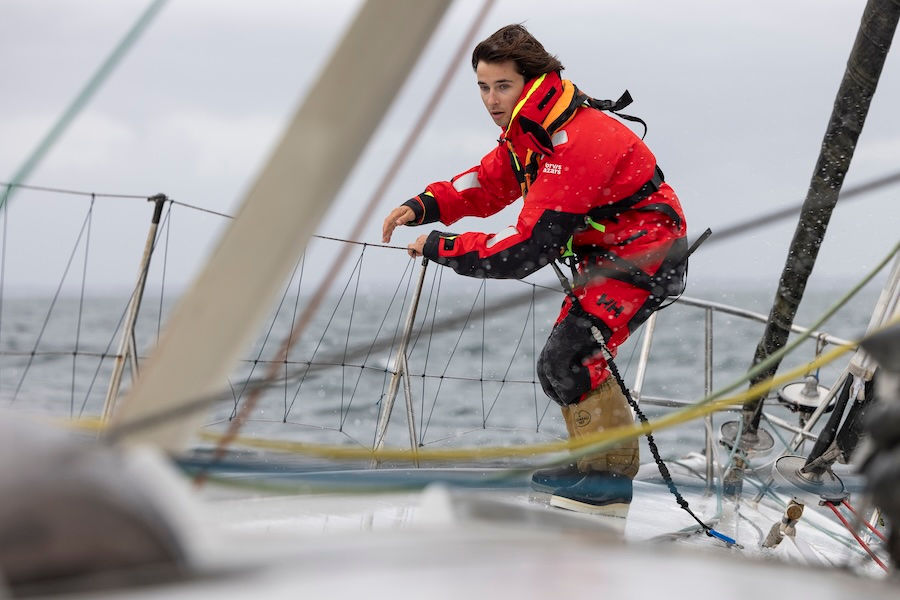


Titouan Pillard (Use it again for youth) @ Jean Marie


retirement project? not for le cam


That is what Jean Le Cam told himself upon discovering Alegria, the Swan 59 in which he is competing in his third Route du Rhum at the age of 67. Why Alegria? "It’s a Frers design and it’s a Swan," the native of Finistère says, as if it were the most obvious thing in the world—"a boat that’s truly worth it!"


For five years, Le Cam—who has been at the cutting edge of racing technology, from Formule 40s and IMOCAs to ORMA multihulls and the Hydroptère—has set his sights on this classic boat from the Finnish shipyard, with its timeless lines.


A meticulous man, Jean has overhauled his Swan from keel to masthead; he sets off equipped with heating, air conditioning, gleaming woodwork, and... two reliable autopilots.


"It’s a heavy boat—not necessarily easy when sailing downwind—and I’m still getting to know it. I’m heading off on a bit of an adventure. It’s a challenge, and one that I’m sure many people will be able to relate to."


Fans will be hoping for the return of his famous "tac-tac-tac" video tips—those cleverly shared secrets that helped forge the legend of this "vintage" skipper, who clearly hasn't had enough of ocean racing yet.


Jean Le Cam à bord de son Swan 59 Alegria @ DR


Oct 23
5 min read

For the "Vintage Mono" class, it’s all about history, and the stories that they bring! While other classes in the Route du Rhum-Destination Guadeloupe have to adhere to strict measurement rules to level the playing field and crown the best skipper, the Vintage Mono class takes a different view.


Here in a fleet of 13 diverse boats the focus is on adventure. The boats range from 12 to 26 meters but which are still classified according to their real time finishing order.

In keeping with the abiding ethos of this historic Transatlantic sprint from Saint Malo to Guadeloupe, which takes place only every four years, you’ll find a lively mix of professional and amateur sailors, a wonderful blend of generations. This remains a class that really resonates with the public!


The 20th century rocks


The 1994 edition of the Route du Rhum was the first to rank multihulls and monohulls separately. Before that the race had a rather rocky relationship between the two.  Canadian Mike Birch won the first-ever Route du Rhum in 1978 aboard his yellow trimaran Olympus Photo, beating Michel Malinovsky's large monohull Kriter V by just 98 seconds after a 23-day Atlantic crossing.

Some would say Malinovsky did not learn his lesson. In 1982, he returned with the radical Kriter VIII—a long, 23-meter aluminium "cigar"—and finished 10th. That philosophical rivalry between Mono and Multi contest was effectively over. Just like stereo took over from mono, so multihulls prevailed in terms of raw speed on the Transatlantic routes. Monohulls would have to wait until the first Vendée Globe in 1990 for their revival.

These transitional years sparked a flurry of architectural experimentation, including 50- and 60-foot classes, an aborted attempt at a one-design round-the-world race, and "racer-cruiser" versions of these stripped-down, high-performance craft—all of which now form the heart of the Vintage Mono category.


A Heritage to Cherish


But back to Kriter VIII. The very boat that signaled the end for monohulls—outclassed in 1982 by the trimarans and catamarans—is lining up this year for its sixth Route du Rhum. It’s fair to say that this Mauric design could be a contender for an award for loyalty and persistence. Its skipper, Wilfried Clerton—setting off for the fourth consecutive time (having placed 3rd in 2022)—loves the idea of ​​honoring its history.

"Back in 1982, I was just a kid hanging around the docks in La Rochelle. I was fascinated by the boat—its color, its proportions. Michel Malinovsky would often invite me aboard, but I never dared to—he had a German shepherd that absolutely terrified me!"

After a lifetime spent racing in Olympic classes and the Class40 circuit, Clerton stumbled upon a classified ad and bought the boat in 2014. Since then, Kriter VIII has been his constant companion on every voyage; Clerton, who has "given everything" for this vessel, says as much. Due to budget constraints—he now works as a marine surveyor—he is heading to Guadeloupe with only the bare minimum of insurance (covering just the start and finish). Yet, he has immense confidence in his boat out on the open ocean—a boat prepared with the help of family and friends.

"

The 'Vintage' class is a way of coming back down to earth," confirms Sidney Gavignet, who, during his early career as a professional skipper, was accustomed to large budgets and extensive support teams. A winner in this class in 2018, he returns this year at the helm of the famous "red cigar" once sailed by Jean-Luc Van Den Heede. A design rarity—notable for its narrow beam and yawl rig—this Harlé-Mortain design is a true legend of the Vendée Globe, having finished second in the 1993 edition; this year marks its fifth Route du Rhum. It is a sturdy, battle-tested boat, and Gavignet sets off with a sense of calm, intending to "play the racing game"—as he puts it. There will certainly be competitiv, but it will be a measured approach, with risks carefully calculated. Family Stories

It is in this same spirit that Tanguy Caradec (Eurvad)—one of the three sons of Loïc, who perished during the tragic 1986 edition of the Route du Rhum—is setting off. For this 46-year-old digital entrepreneur, his participation serves as a tribute. Sailing a 50-foot Open boat with a canting keel, he embarks on this personal journey to "bring things full circle." However, he will face two other competitors with very similar vessels, setting the stage for a "race within a race." At 67, Patrick Isoard (sailing for Groupe Cogedis pour enfants du Mékong) is by far the most experienced of the three; he has been meticulously preparing since 2023, bringing with him the experience of four previous transatlantic crossings and several victories, including the Transat CIC. Meanwhile, 20-year-old Titouan Pillard (Use it again for youth)— is the youngest sailor in the event—is taking on his first solo Atlantic crossing, following in the footsteps of his father, who is actually competing in the "Vintage Multi" category.


This trio could well be at the front of the pack once they unfurl their sails in the trade winds. Yet, other competitors may give them a run for their money, particularly in the first leg of the course—such as Christophe Bachmann, who is skippering Grain de Sable (formerly Jean-Luc Vande Heede’s Adrien) This 26-meter Vaton design—which held the record for a "wrong way round " (westward) circumnavigation until last year—should really hit its stride when sailing upwind, provided its skipper from Dinard, a long-time veteran of the Class40 circuit, can fully harness its potential while sailing solo.


Another contender to watch closely in the race to Pointe-à-Pitre is Kieran Le Borgne, sailing Armor Lux - Le Finistère assurance. The 28-year-old from Brest performed a valuable service by rescuing the former PRB—the only boat to have won the Vendée Globe twice (in 2000 and 2004)—from abandonment; it had been left to decay for 13 years, yet this piece of offshore racing heritage is back on the race course and still retains its full potential.


Titouan Pillard (Use it again for youth) @ Jean Marie


retirement project? not for le cam


That is what Jean Le Cam told himself upon discovering Alegria, the Swan 59 in which he is competing in his third Route du Rhum at the age of 67. Why Alegria? "It’s a Frers design and it’s a Swan," the native of Finistère says, as if it were the most obvious thing in the world—"a boat that’s truly worth it!"


For five years, Le Cam—who has been at the cutting edge of racing technology, from Formule 40s and IMOCAs to ORMA multihulls and the Hydroptère—has set his sights on this classic boat from the Finnish shipyard, with its timeless lines.


A meticulous man, Jean has overhauled his Swan from keel to masthead; he sets off equipped with heating, air conditioning, gleaming woodwork, and... two reliable autopilots.


"It’s a heavy boat—not necessarily easy when sailing downwind—and I’m still getting to know it. I’m heading off on a bit of an adventure. It’s a challenge, and one that I’m sure many people will be able to relate to."


Fans will be hoping for the return of his famous "tac-tac-tac" video tips—those cleverly shared secrets that helped forge the legend of this "vintage" skipper, who clearly hasn't had enough of ocean racing yet.


Jean Le Cam à bord de son Swan 59 Alegria @ DR


bottom of page