


In terms of risk management, offshore racing has considerable experience, as a motorsport taking place in a potentially hostile natural environment. Organizers also face the risk of race start postponements due to weather conditions. How do they address this? We explore some answers from the Route du Rhum - Destination Guadeloupe, of which AMRAE is a partner.
“Postponing a start is a huge disruption to the entire offshore racing community and has logistical, economic, and media consequences ,” emphasizes Francis Le Goff, race director of the Route du Rhum - Destination Guadeloupe. “This is an issue that requires maximum anticipation because this situation is no longer ‘extraordinary’; we are developing contingency plans to address this problem ,” adds Julie Coutts, managing director of OC Sport Pen Duick, which organizes the event.
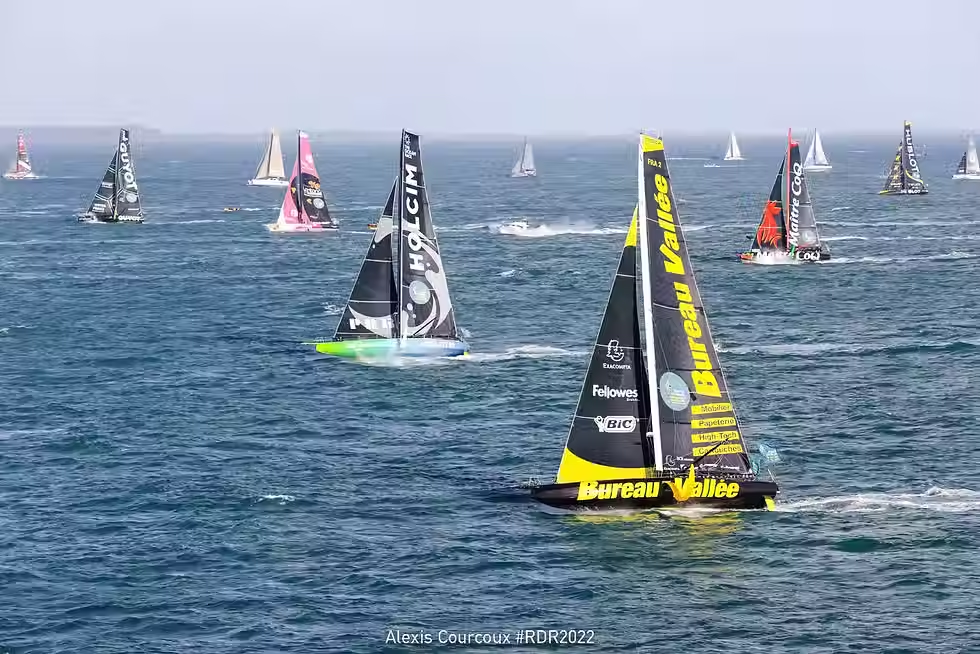
The 2022 edition of the Route du Rhum - Destination Guadeloupe is a perfect illustration of this, as the start was postponed by three days. The goal, however, is to avoid postponements as much as possible, as Francis Le Goff confirms: “We have included in the Notice of Race, starting with the 2022 edition of the Route du Rhum - Destination Guadeloupe, the possibility of bringing the start forward by 24 hours if the situation is too complicated to start on the scheduled day or if conditions are too difficult at the exit of the English Channel or in the Bay of Biscay two days after the start.” In this case, the sailors must be notified at least 48 hours in advance, and everything must be technically operational. “Whether it's the mobilization of the teams responsible for the start on the water, "The lock slots at Saint-Malo, the buoys in front of the Rance dam or in Dinard which accommodate the ULTIM and IMOCA boats two days before the start – everything has been anticipated," explains the race director. "This allows us to be flexible in our decision-making."

“It is the organizer who bears the financial risk.”
For its part, OC Sport Pen Duick is anticipating the risk of postponement by listing the impacts in terms of communication, logistics, and finances. “For each of these, we are assigning a specific action and a designated contact person in order to establish a robust and effective plan,” explains Julie Coutts. “ We are also working with the administrative authorities to ensure that our permits and the various regulations concerning the use of the port and the setup of the race village or the start on the water allow us a three-day postponement, a period we consider sufficient to allow time for a storm to pass.”
In parallel, OC Sport Pen Duick is working with the hundred or so service providers involved in the event – hotels, audiovisual production companies, the company responsible for setting up and taking down the village tents, etc. – to assess how they would be impacted in the event of a postponement. “Wherever possible, we identify and define clauses and list the potential financial impacts,” explains Julie Coutts, before adding: “It is indeed the organizer who bears this financial risk. And since there is no insurance to mitigate the risk of this postponement, we have established a budget provision representing 1% of the operational budget.”
Regarding the arrival in Guadeloupe, while the impact is less and easier to understand, particularly because arrivals “always have their share of uncertainties and require us to be very flexible, we must nevertheless work on a postponement scenario, including delaying the opening of the village by a few days,” emphasizes Julie Coutts.

Concerted and multi-factorial decision
How is a decision made to postpone a start? “There are no specific alert thresholds; it's the analysis of all the meteorological factors that allows us to make a decision,” emphasizes Francis Le Goff. “ When we postpone or cancel a start, it's because we're certain that the fleet won't be able to find shelter if the conditions are too difficult, nor escape using its own speed.”
And while on paper it is the race director who takes personal responsibility by deciding whether or not to start the race, “the reality is more collective, many stakeholders meet regularly to contribute to this discussion and allow for informed decision-making at the best time,” emphasizes the general manager of OC Sport Pen Duick.
The analysis of weather files begins ten days before the start “in order to monitor the evolution of the systems and see if they are stable or not,” explains Francis Le Goff. “Our weather unit, which has been strengthened over the years, consists of a key partner, Météo Consult, with its two dedicated meteorologists and their team; and within the management, my first deputy Yann Chateau carries out routings to analyze how our fleets will behave in relation to the forecasted systems.”
From the moment conditions deteriorate and the risk is real and identified, race management regularly consults with the organizer and the various class representatives to best anticipate what will happen. “Our goal is to be clear and concise so we can move forward together and not catch anyone off guard,” emphasizes Francis Le Goff. “ We have to consider the turmoil raging inside the sailors' heads at that moment. They're programmed to depart at a specific time, so when the decision is made, even if there's a sense of relief and a release of pressure, they then have to regroup and reassess their weather and routing strategies.”
And Julie Coutts continued: "In parallel with the discussions taking place on the sporting side, we are immediately activating all the teams with our service partners and the media so that everyone can anticipate the different scenarios. A delayed start from Sunday to Wednesday has very concrete consequences, particularly on attendance and hospitality programs. Our responsibility is therefore to limit the impacts by securing, as much as possible, the visibility of partners, including those of participants, and the experiences of guests; we ensure that their media coverage and BtoB experiences are secured before departure.”
“Absorb, integrate and manage risk”
“Since we are never immune to climate hazards, the idea is rather to identify, integrate and manage the risk rather than trying to protect ourselves from it,” she explains . “The challenges are the same for businesses, and that’s why we felt so aligned in our partnership with AMRAE ( Association for Risk Management and Insurance in Business) .”
Amélie Sapin, also a member of AMRAE as Head of Insurance at Alten, explains: “While the methodology for anticipating risks is the same for a company or a sporting event, risk management is very different.”
The former Insurance Manager for the Paris 2024 Olympic and Paralympic Games Organizing Committee adds: " Whether it's the Olympics or the Route du Rhum - Destination Guadeloupe, when there's a proven risk, we only have a few hours or a few days to react, so the urgency is greater. The unknown in crisis management is also much greater because there are a multitude of stakeholders we don't know as well as in a company; the human aspect is more difficult to grasp; there's also a kind of adrenaline rush to manage with operational staff running around in all directions."
Amélie Sapin, who also co-leads the “special risks” working group within AMRAE, concludes: “Regarding these events, it is essential to conduct feedback on what happened and what can be improved to best prepare for potential future risks.”
