


The two categories, which are part of the DNA of the Route du Rhum-Destination Guadeloupe, are evolving. The goal: to favor the boats and skippers who have made history in the race. And it's working. On the boat side, there are four ORMA trimarans, the only IMOCA to have won two Vendée Globe races, and numerous other boats that have contributed to writing the legend of offshore racing. As for the skippers, the public will appreciate the participation of a former winner (Francis Joyon), renowned skippers (Jean Le Cam, Damien Seguin, Éric Péron), as well as knowledgeable amateurs eager to live out a dream.
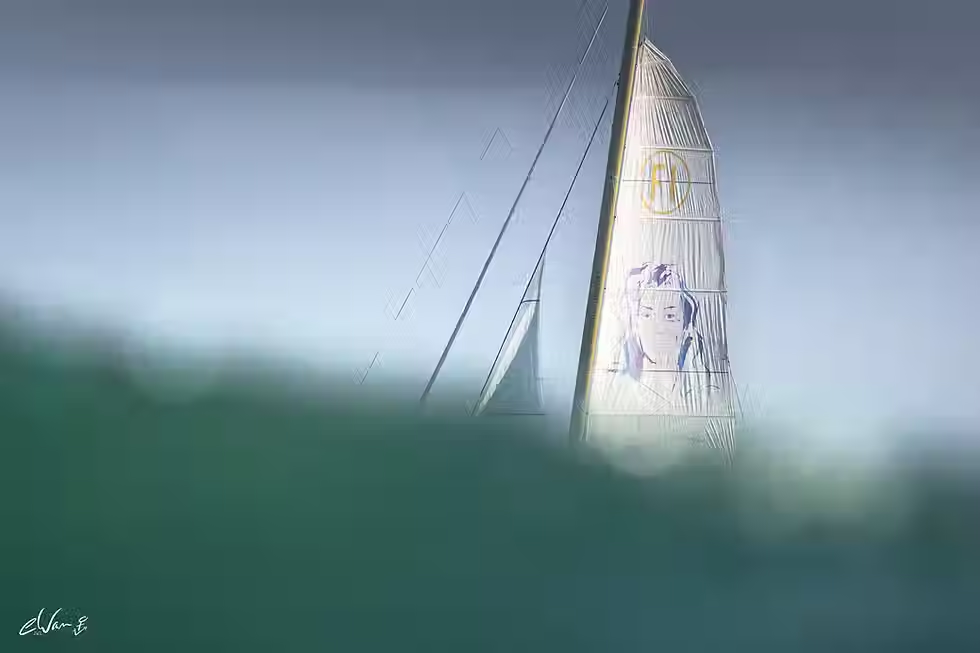
You might have to rub your eyes to believe it. Alongside the technological marvels that are the Ultims, IMOCAs, Ocean Fifties, and Class40s, there are older boats, legends of yesteryear, hulls with a history that thrilled enthusiasts in their time. The Vintage Multi and Mono classes are anything but a nostalgic revival. It's history brought back into the present, an opportunity to breathe new life into legendary boats and excite all lovers of the sport. The name change – from "Rhum Multi" and "Rhum Mono" to Vintage Multi and Vintage Mono – is therefore anything but a semantic shift. Race director Francis Le Goff sums it up in his own way: "The initial principle behind these categories is to encourage the return of the boats and skippers who helped write the history of the Route du Rhum." A reality and a spirit instilled in both multihulls and monohulls by the skippers who have committed themselves. "What's interesting is that we're seeing boats returning that competed in, or even won, the Route du Rhum in their time."
Vintage Multi, "legendary skippers and boats"
One of the major attractions of the 2026 Route du Rhum-Destination Guadeloupe will undoubtedly be the presence of four ORMA trimarans, those legendary multihulls from the 1990s and 2000s. And on board will be renowned skippers: the winner of the 2018 edition, Francis Joyon ( Pour les Océans ), Damien Seguin ( Arkéa-Handicap International) , Éric Péron ( French Touch Oceans Club ), and Gilles Lamiré ( Groupe GCA ). "What's interesting is that it will compress the time frame," explains Francis Le Goff. "The first boats could arrive between the Ultim trimarans and the Ocean Fifty trimarans."
In short, if the conditions aren't too harsh, they can expect to cross the Atlantic in 8 to 10 days. "With well-known skippers, legendary boats, and a short race, it's going to generate a lot of interest from the public and the media." However, the challenge isn't without its dangers. "We know these boats are unpredictable, and there have been many incidents in the past," Francis Le Goff points out. "It will require constant vigilance from the skippers, but also from the race management."
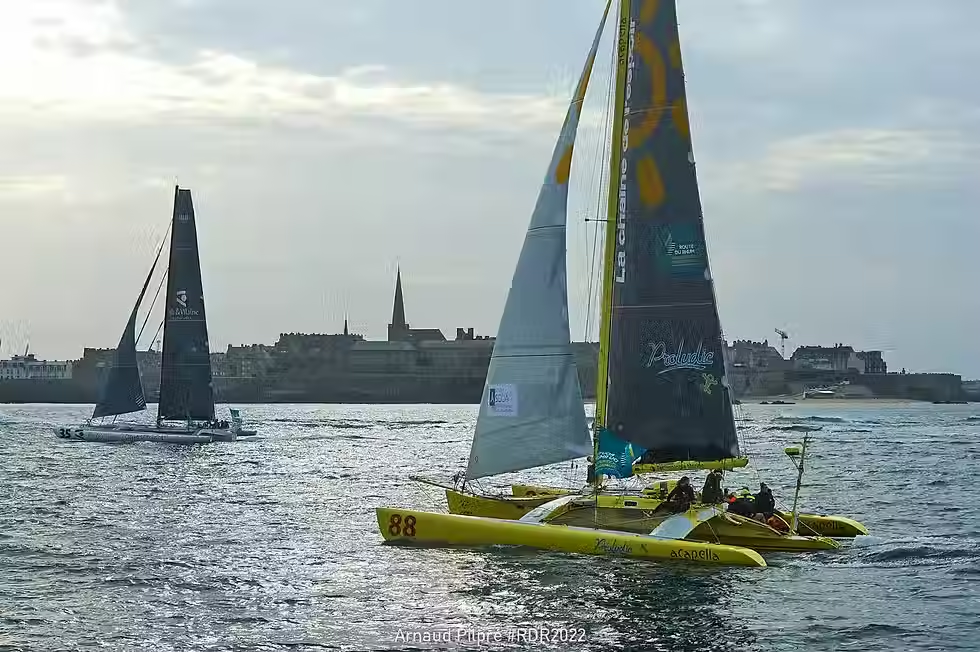
Within the Vintage Multi class, there are also two other big names in offshore racing: Roland Jourdain (We Explore) and Marc Guillemot (Dazeilad). Both skippers are committed to an eco-responsible approach. "Bilou" will indeed be competing in the race with his boat made of flax fiber, while Marc Guillemot has salvaged several components from other boats (the spar from Jean Le Cam's IMOCA, Damien Seguin's daggerboards, the rudders from a former Jérémie Beyou boat, etc.). Also noteworthy in this category is the presence of the ever-present Charlie Capelle ( Acapella – Proludic – La Chaîne de l'Espoir, Vintage Multi) . The oldest competitor in this edition, at 71 years old, he is indeed participating in the race for the 7th time aboard a small 38-foot trimaran (the minimum size required to start, according to the Notice of Race). This is a boat inspired by the first winner of the Route du Rhum, Mike Birch.
Vintage Mono, knowledgeable enthusiasts, and beautiful stories
Here again, the category remains true to the DNA of the Route du Rhum. "There are many amateurs, passionate sailors who want to compete in a major race while facing the challenging conditions of autumn," explains Francis Le Goff. "And then there are also some legendary boats." Among them is the former Kriter VIII, the "Grand Cigare," designed by Michel Malinovski and famous for its three consecutive Route du Rhum victories in 1982, 1986, and 1990. Wilfried Clerton, who participated in the last two editions, will be at the helm. Hugo Lefort will be aboard the Cigare Rouge, launched in 1991 by Jean-Luc Van Den Heede, which has three Vendée Globe races under its belt (Catherine Chabaud, Joe Seeten, Karen Leibovici). Architect Christophe Bachmann also has a renowned boat, Grain de Sable . This is the former Adrien with which Jean-Luc Van den Heede had beaten the round-the-world record against the prevailing winds, a monohull which was later taken over by Maud Fontenoy.
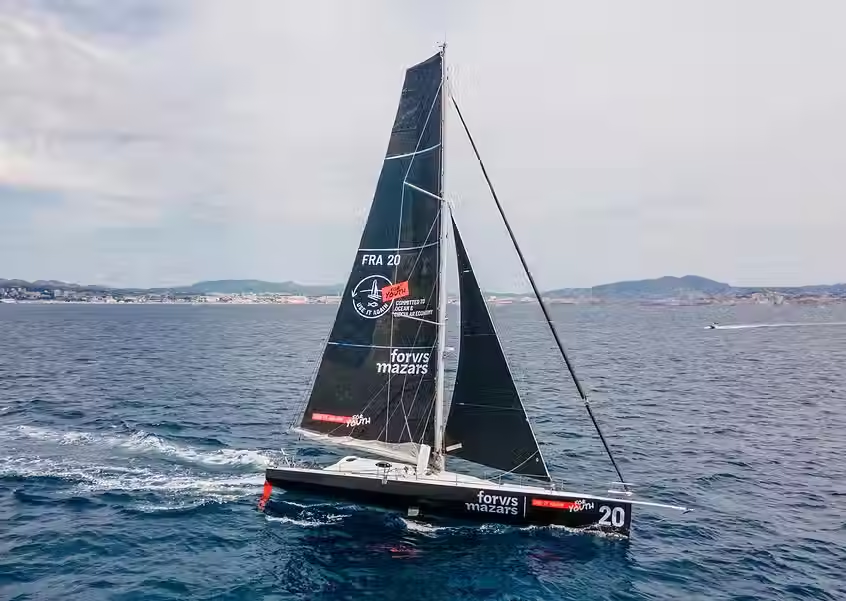
Tanguy Caradec's Route du Rhum (Eurvad) will be followed with great interest, as he follows in the footsteps of his father, an offshore racing legend who tragically died during the 1986 edition. Tanguy will be at the helm of a 50-footer, as will Patrick Isoard ( USHIP for Enfants du Mékong ) and Titouan Pilliard ( Use it Again for Youth ). The latter, son of Romain, who is also competing in the Vintage Multi class, is taking on a formidable challenge at just 20 years old. In any case, the competition in this category promises to be fierce, especially since Jean Le Cam, who has undertaken the restoration of a Swan 59 for the occasion, will also be a contender.
Kieran Le Borgne, who competed in his first Route du Rhum-Destination Guadeloupe four years ago in the Class40, has also embarked on a restoration project by acquiring a legendary former IMOCA. This is Aito , the only boat to have won two Vendée Globe races under the PRB banner, first with Michel Desjoyeaux in 2000-2001 and then with Vincent Riou in 2004-2005. "Kieran is a pioneer in his own way: we can expect that in the future, other skippers will want to take the helm of older generation IMOCAs." Like the 26 skippers competing in the Vintage Mono and Vintage Multi classes this year, they will contribute to the vitality of a category where giving a second life to legendary boats is so valued.