


A successful entrepreneur and former top-level alpine skier, he decided to shake things up to embark on one of the most extreme sporting challenges: solo offshore racing in an IMOCA, with the mythical Vendée Globe in his sights.
Beyond the personal adventure, this Canadian sailor carries a dual commitment through his Canada Ocean Racing team: to inspire a new generation of sailors in his country, and to raise awareness about the preservation of water resources with the "Be Water Positive" campaign.
An encounter with a man who deliberately chose to become a beginner again in order to push his own limits.
On your background and the Canada Ocean Racing project
#1 You have a very unique background: as a successful entrepreneur and a high-level alpine skier, you decided to take on the challenge of IMOCA ocean racing. What was the exact turning point that made you switch from the business world to the ultra-demanding realm of solo offshore sailing?
Scott Shawyer: People sometimes assume there must have been one dramatic moment, but it wasn't like that. I loved building my business. I spent more than thirty years growing it, working with incredible people and solving difficult problems. It gave me opportunities I could never have imagined.
What changed was me. During the COVID lockdown I found myself working long days behind a screen, and I watched the Vendée Globe for the first time. What struck me was the freedom.
I realised I'd been running on autopilot without even noticing. My life wasn't wrong. It had just become very predictable. That was the moment I gave myself permission to ask a different question: what am I capable of?
The Vendée Globe became my experiment. I don't know exactly where my limits are, and that's precisely why I'm doing it.
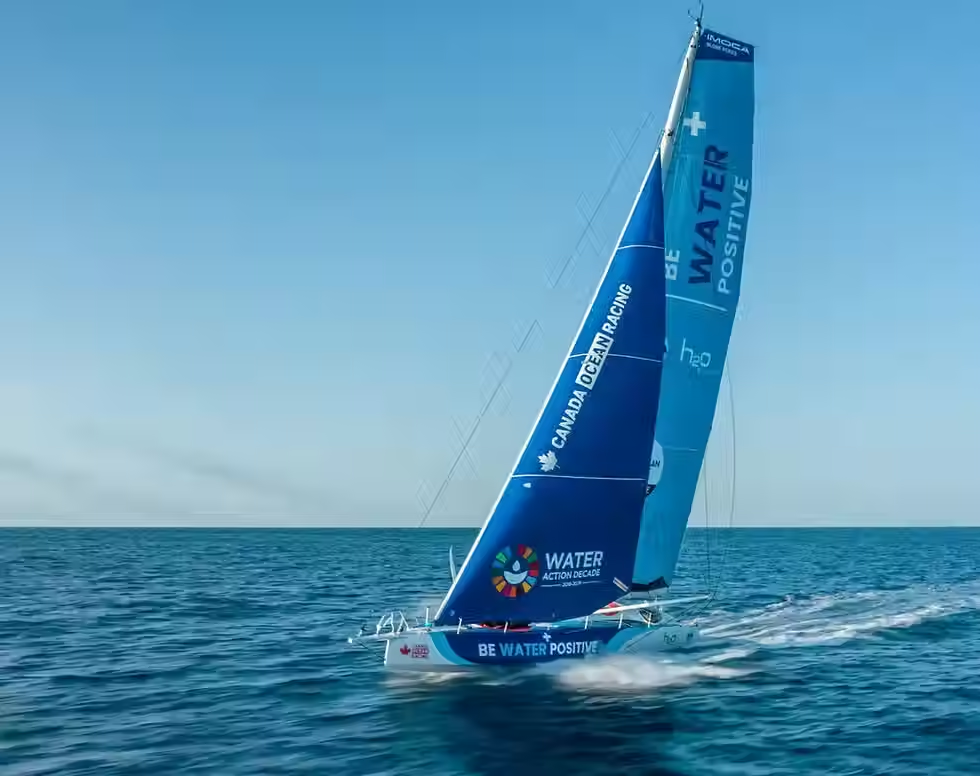
#2 Through Canada Ocean Racing, your stated goal is to help grow offshore racing in Canada and inspire a new generation of sailors. What does it mean to you to fly the Maple Leaf in the IMOCA circuit that has historically been very European-dominated?
Scott Shawyer: I'm incredibly proud to represent Canada, but for me it's about much more than carrying a flag around the world.
Canada has an extraordinary sailing heritage, thousands of kilometres of coastline and some of the largest freshwater lakes on Earth, yet offshore racing has never really established itself in the way it has in Europe.
I don't expect young Canadians to wake up one morning and think, "I'm going to race the Vendée Globe," if they've never met someone who's even tried. Representation matters.
That's why we've launched our Pathway Program. I want young sailors to step onto an IMOCA, meet the team, experience offshore sailing and realise this world isn't reserved for people born in France or other big sailing nations. There is a pathway.
If my campaign helps create the next generation of Canadian offshore sailors, that may end up being the achievement I'm proudest of.
On the Route du Rhum and the "Be Water Positive" commitment
#3 The Route du Rhum - Destination Guadeloupe is a legendary transatlantic race. As a Canadian sailor, what does it mean to you, both as a symbol and a personal challenge, to cross the Atlantic solo from East to West to reach the Tropics?
Scott Shawyer: Every offshore race is another chapter in the experiment.
The Route du Rhum is iconic because it's just you and the boat crossing an entire ocean. There are no other crew members to lean on and nowhere to hide. Every decision is yours.
For me it's another opportunity to learn. Every mile sailed solo teaches me something I'll need for the Vendée Globe. That's really what these races are about.
Crossing the Atlantic alone is something I never imagined I'd do when I was building automation systems in Ontario just 5 years ago. Now I get to test myself in one of the world's great ocean races.
That's both humbling and incredibly exciting.
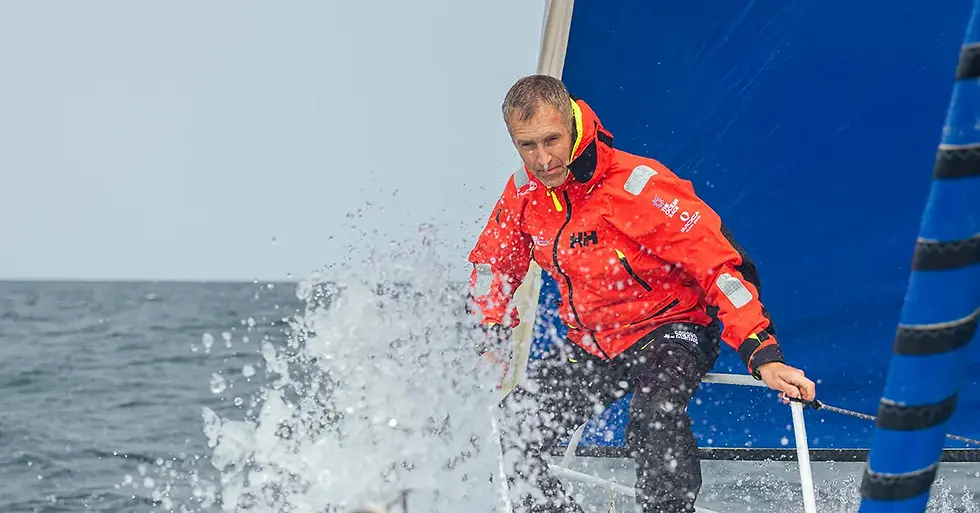
#4 Your boat and project proudly carry the message "Be Water Positive". Can you explain the core mission behind this slogan, and how you plan to use the massive media spotlight of the Rhum to raise public awareness about water resource conservation?
Scott Shawyer: Be Water Positive is about helping people see our water resources differently.
Growing up in Canada, surrounded by the Great Lakes, I took water for granted, like many Canadians do.
Water is one of our most precious resources, yet billions of people already live with water stress, and that challenge is only growing.
Our role isn't to lecture people. It's to use the platform we've built through offshore racing to introduce them to organisations, technologies and people who are developing practical solutions.
The Route du Rhum gives us a global stage, but the conversation isn't really about sailing. Sailing is what opens the door. Once people are engaged with the story, we can have much bigger conversations about innovation, resilience and how we manage one of the world's most valuable resources.
On learning solo sailing and managing the boat
#5 To fast-track your learning curve, you are working closely with a mentor and your campaign’s CEO, Nick Moloney. What is the most valuable lesson or piece of advice he has given you about handling your IMOCA solo?
Scott Shawyer: Nick has an ability to simplify what can seem overwhelmingly complex. He has raced around the world multiple times, but he never makes it sound mysterious or unattainable. He breaks it down into the next decision, the next manoeuvre, the next lesson.
One thing he's reinforced is that you don't become a Vendée Globe skipper overnight. You become one race, one training session and one problem solved at a time.
Nick talks about something he calls "pebbles in the locker," and it's probably the most valuable lesson he's shared with me.
The idea is simple. Every good training session, every skill you master, every problem you solve and every lesson you learn is like putting another pebble in your locker. On race day, if doubt creeps in, you open that locker and all those pebbles spill out. They're a reminder that you've done the work.
I love that way of thinking because it's very practical. It's about showing up every day, doing the work, learning something new and putting another pebble in the locker.
Nick is brilliant at helping me recognise those pebbles. Sometimes you're so focused on how much there is still to learn that you don't notice how far you've already come. He helps me see the progress, while always keeping me focused on the next thing.
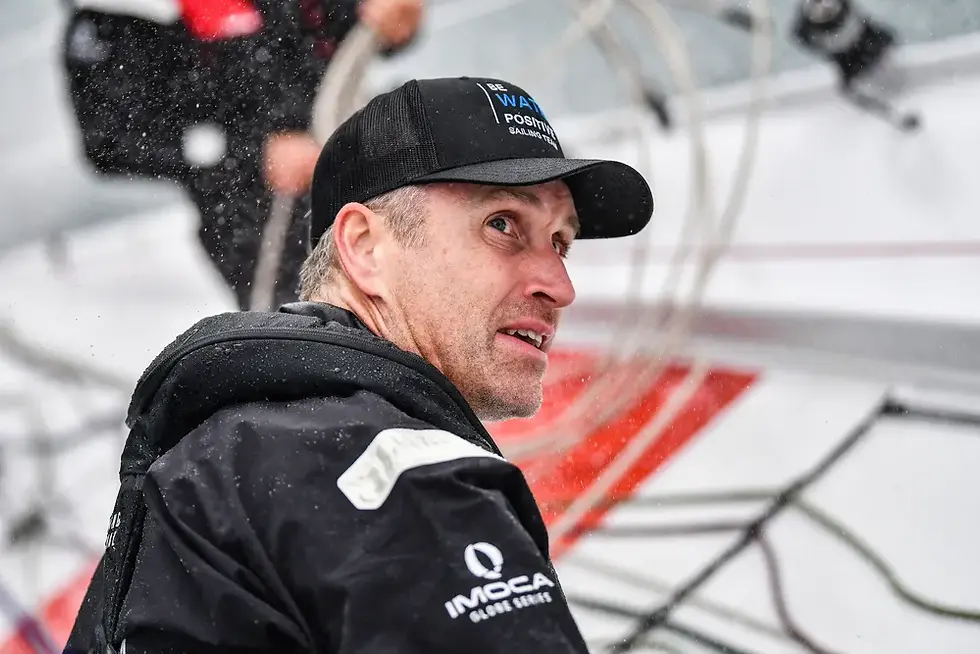
#6 Moving from an adventurer/entrepreneur mindset to becoming an offshore racing skipper requires a massive learning curve. What has been the hardest part for you to master: the technical and technological complexity of these boats, or managing solitude and sleep while facing the elements?
Scott Shawyer: The technical side is actually where I feel most comfortable.
I'm an engineer, so I enjoy understanding complex systems and figuring out how things work. These boats are extraordinary machines and I genuinely enjoy learning about them.
The harder part is becoming a truly instinctive offshore sailor.
It's learning to make good decisions when you're exhausted, sleeping in twenty-minute blocks, dealing with constantly changing weather and knowing that every decision has consequences because you're completely alone.
These races aren’t won by the person who sails the boat the fastest for one afternoon. It's about making thousands of good decisions over extended periods of time.
That's what I'm trying to learn, and I'm still learning. I think that's important to say. I deliberately chose to become a beginner again, on one of the biggest stages in sport. That's uncomfortable, but it's also what makes this whole project worthwhile.